Jaipur is a city most people visit to see the forts inside the city itself. The palaces and bazaars are worth every hour. But the 100 km radius around the Pink City holds India’s most talked-about haunted fort, its largest inland salt lake.
This guide covers the best places to visit near Jaipur under 100 km with actual travel information, not just names and distances. Every destination includes its route, what you will see, and what it costs, so you can plan the trip without guessing. October to February is the best season across all of them.
Places to Visit Near Jaipur Under 100 km: A Few Things to Know Before You Leave Jaipur
The 100 km radius around Jaipur is not green hills and waterfalls. This is Rajasthan, and the landscape around the city is Aravalli scrub, salt plains, medieval ruins, and temple towns built from red and gold sandstone.
Winter from October to February is when Rajasthan is at its best. The mornings drop to 8 to 10 degrees Celsius between December and January, which means you need a jacket before 10 AM. Summer from April to June is manageable for early morning trips but temperatures cross 40 degrees by noon. Monsoon from July to September brings the Aravalli Hills alive and makes Sambhar Lake particularly atmospheric.
One more thing worth addressing before the destinations: the most common question in every search about this region is whether there is a hill station within 100 km of Jaipur. There is not. Mount Abu, Rajasthan’s only proper hill station, is 500 km away. The Sariska forest area at 98 km is the closest you get to elevated terrain and cool air within this radius.
6 Best Places to Visit Near Jaipur Under 100 km
Each destination below is genuinely worth the drive. They span forts, lakes, temples, wildlife, and ancient stepwells. The furthest on this list is 98 km from Jaipur and the closest is a 20-minute drive. All six are doable as day trips. Two of them make a stronger case for an overnight stay.
Bhangarh Fort (83 km)
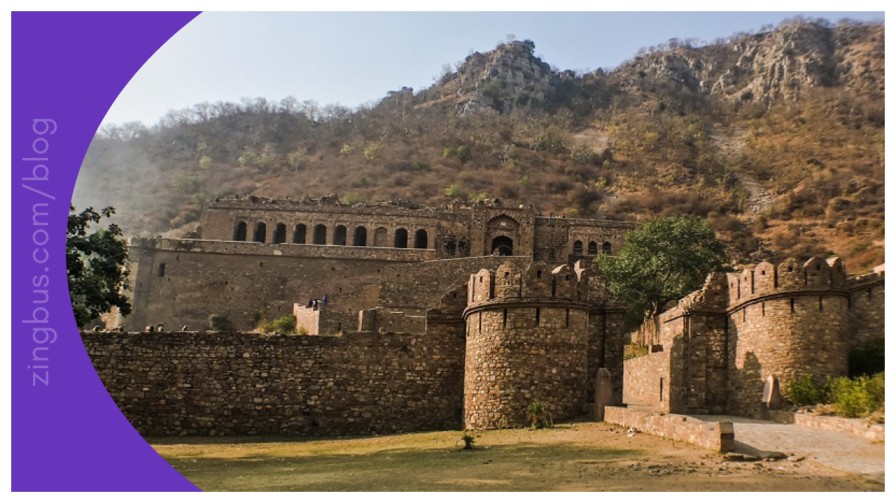
Bhangarh Fort has a reputation that precedes it by centuries. The Archaeological Survey of India posts a notice at the gate prohibiting entry before sunrise and after sunset, which is the most official acknowledgement of a haunted site you will find anywhere in India. Ghost stories aside, the 17th-century Kachwaha fort is architecturally impressive in broad daylight, with three levels of ruins, carved temples, and open courtyards set against the Sariska forest backdrop.
Distance and Route: 83 km via NH 248A toward Alwar, then state road through Dausa district. The last 12 km to the fort from the main road are on a narrower state highway. Drive time is 2 to 2.5 hours. Start no later than 7 AM to reach comfortably before the day heats up.
What You Will See: The Gopinath Temple at the fort entrance, Someshwar and Mangla Devi Temple ruins, palace chambers across three levels, a ruined marketplace, and the Aravalli Hills on all sides. The view from the uppermost level looks out over the tiger reserve.
Main Cost Factors:
- Entry fee: Rs 40 for Indian nationals, Rs 200 for international visitors
- Food: No restaurants inside the fort. Carry food or eat at roadside dhabas on the Alwar highway before the Bhangarh turnoff
- Combined day trip: Chand Baori at Abhaneri is 35 km from Bhangarh, making a strong double destination on the same day
Sambhar Lake (80 km)
Sambhar is India’s largest inland saltwater lake and one of the more unusual day trips in the entire Jaipur radius. The lake itself looks like something between a Rann of Kutch salt flat and a flamingo wetland. From November to February, tens of thousands of migratory birds including flamingos, pelicans, and waders feed in the shallow water. The salt works on the lake edge have been operating for centuries and are still active today.
Distance and Route: 80 km from Jaipur via NH 58 toward Phulera, then state road to Sambhar town. Well-surfaced road throughout with no tricky sections. Drive time: 1.5 to 2 hours. State RSRTC buses also run from Jaipur to Sambhar town directly.
What You Will See: The salt production pans and lake edge at sunrise, migratory flamingos in winter months, the Shakambhari Mata Temple on the lake shore, and the remains of the old narrow-gauge Sambhar Salt Railway line.
Main Cost Factors:
- Entry: No formal entry fee for the lakefront viewpoint
- Photography: Drone use requires prior permissions from the salt works authority
- Stay: Budget guesthouses available in Sambhar town if you want a sunrise visit
Khatu Shyamji Temple (80 km)
Khatu Shyam Ji is one of the most spiritually significant temples in Rajasthan and one of the most visited pilgrimage sites in North India on full moon days. The temple is dedicated to Barbarika, grandson of Bhima from the Mahabharata, who was granted a boon by Lord Krishna. The white marble sanctum is calm during weekday mornings and extraordinary during the Phalguna festival held in February and March.
Distance and Route: 80 km from Jaipur via NH 58 toward Ringas, then 15 km to Khatu village. You can take a Jaipur to Sikar bus and deboard at Ringas junction, from where local autos cover the remaining 15 km to the temple.
What You Will See: The white marble temple, the phalguna festival pandals in season, and the surrounding bazaar with Rajasthani sweets and religious offerings. The town is small and best experienced before 10 AM.
Main Cost Factors:
- Entry: Free at all times
- Offerings and prasad: Rs 50 to Rs 200 depending on what you choose
- Temple opens at 4:30 AM; best visited by 8 AM to avoid midday lines on weekends
Chand Baori at Abhaneri (95 km)
Chand Baori is one of the most photographed structures in Rajasthan that most people outside the state have still not seen in person. The stepwell was built over 1,200 years ago by the Rajput King Chanda and descends 20 metres below ground across 3,500 symmetrically arranged steps on three sides. The fourth side is a multi-storey ornamental facade with carved panels and galleries. It is architecturally unlike anything else in the 100 km range.
Distance and Route: 95 km from Jaipur via NH 21 toward Agra, exit at Abhaneri village near Dausa. Drive time: 2 to 2.5 hours. State buses from Sindhi Camp Bus Stand on the Agra route also stop at Dausa, 6 km from Abhaneri.
What You Will See: The stepwell and its geometric precision, the adjacent Harshat Mata Temple dating to the 8th century, and the small ASI museum on site with recovered stone sculptures. Early morning and late afternoon light makes the photography exceptional.
Main Cost Factors:
- Entry fee: Rs 35 for Indian nationals at the Harshat Mata Temple complex enclosure
- Chand Baori is free to view from the street: entry inside the complex has the fee
- Combine with Bhangarh Fort: 35 km away, making this one of the best double-stop day trips near Jaipur
Sariska Tiger Reserve (98 km)
Sariska was the first tiger reserve in India to successfully relocate tigers from Ranthambore and has a steady population of Royal Bengal Tigers across its 866 sq km of Aravalli forest. It is also the most nature-forward experience within the places to visit near Jaipur under 100 km. Inside the reserve, the 10th-century Garh-Rajor temple ruins and the medieval Kankwari Fort add a heritage layer that most wildlife reserves do not have.
Distance and Route: 98 km from Jaipur via NH 48 toward Delhi. The highway is well-maintained and clearly signposted. Drive time: 2 hours. A Jaipur to Alwar bus drops passengers near the Sariska gate, from where local cabs reach the reserve entrance.
What You Will See: Royal Bengal Tigers, leopards, sambar deer, nilgai, wild boar, the Garh-Rajor temple ruins, Kankwari Fort inside the forest, and striped hyenas on evening safaris.
Main Cost Factors:
- Jeep safari fee: Rs 600 to Rs 1,200 per person depending on zone and slot (confirm current official rates before visiting)
- Safari timings: 6 AM to 10 AM and 3 PM to 6 PM daily
- Stay: Forest rest houses and mid-range hotels available near the reserve gate for an overnight plan
Siliserh Lake (73 km, via Alwar)
Siliserh Lake is the most scenic picnic destination within the Jaipur 100 km radius and the most consistently overlooked. The artificial reservoir was created in 1845 by Maharaja Vinay Singh of Alwar for his queen, and a lakeside palace was built on the shore. The Aravalli Hills surround the lake on three sides, and the late afternoon light across the water is one of those views that makes the whole drive worth it.
Distance and Route: 13 km from Alwar town, making the total distance from Jaipur approximately 73 km via NH 48. Drive time: 1.5 to 2 hours. Take the Jaipur to Alwar highway and follow the Siliserh signs from Alwar junction.
What You Will See: The heritage Siliserh Palace on the lakefront, rowboat rides on the reservoir, Aravalli Hill reflections in the water, crocodile sightings near the reeds, and the western shore at sunset.
Main Cost Factors:
- Boating: Rs 100 to Rs 200 per person for a 30-minute lake ride
- Palace hotel entry for non-guests: Day visits allowed; restaurant meal Rs 300 to Rs 700
- Combine with: Sariska Tiger Reserve is 20 km from Siliserh, making it the strongest two-stop day trip from Jaipur in this entire guide
How to Reach These Places from Jaipur
Most of the destinations in this guide sit on two main highways from Jaipur. The NH 48 toward Delhi covers the northern direction for Sariska and Siliserh. The NH 21 toward Agra serves the eastern direction for Abhaneri and Bhangarh. Sambhar and Khatu Shyamji are northwest on NH 58. Getting there by bus, train, or road all have their own merits depending on the destination.
By Bus
Buses on the Jaipur to Ajmer route with 7 departures and Jaipur to Sikar with 4 departures. For Khatu Shyamji, board the Sikar-bound bus and deboard at Ringas, then take a local auto for the final 15 km. For Sariska and Siliserh, the Jaipur to Alwar route drops you at the closest junction.
- Sindhi Camp Bus Stand in Jaipur is the main hub for state buses to Dausa, Abhaneri, and Sambhar
- RSRTC state buses run to Sambhar directly from Jaipur on regular schedules
By Train
Jaipur Railway Station connects to Alwar and Dausa with direct trains. For Sariska and Siliserh, deboard at Alwar and take a cab for the final 13 km to Siliserh. For Abhaneri, Dausa Station is 6 km from the stepwell. Trains add scenic value through the Aravalli landscape but limit flexibility for multi-stop day trips.
By Road
Self-drive is the most practical approach for Bhangarh Fort, Sambhar Lake, and any plan combining two destinations. The NH 48 to Sariska and the NH 21 to Abhaneri are both clearly marked and maintained. Fuel up in Jaipur before leaving since petrol stations on rural Rajasthan roads become sparse after the outskirts.
You Might Also Like
Carry These Essentials
Jaipur’s 100 km radius is open country, rural highways, and semi-arid forest. Most destinations have minimal infrastructure on site. What you carry from the city determines how comfortable and safe the trip turns out to be.
- Water: At least 2 litres per person; food and water are scarce at Bhangarh and Chand Baori
- Sun protection: SPF 50 and a wide-brim hat are non-negotiable between March and October
- Cash in small denominations: Entry counters, dhabas, and autos do not accept cards
- Government ID: Required at ASI-managed sites including Chand Baori and Bhangarh Fort
- Start early: Sariska safaris open at 6 AM; Bhangarh is best before 9 AM before heat and crowd
- Light jacket: November to January mornings in the Aravalli Hills drop to 8 to 10 degrees Celsius
- Offline map: Mobile network drops on rural Rajasthan roads between destinations
Rajasthan’s 100 km Doesn’t Need a Hill Station to Be Worth It
The places to visit near Jaipur under 100 km are not lush forests and waterfalls. They are something more specific to this corner of India: a haunted fort on a tiger reserve border, a pink flamingo lake in the middle of a salt plain, a stepwell that took a king decades to build. These are not generic weekend destinations. They are things that only exist here.
Pick any two from this guide and combine them on a single day. Bhangarh and Chand Baori pair well on the eastern corridor. Sariska and Siliserh pair perfectly on the northern one. For getting there, check available bus departures on the Jaipur to Alwar and Jaipur to Sikar routes before locking in dates. Both routes run daily and fill up on long weekends.
Frequently Asked Questions
Ques: What are the best places to visit near Jaipur within 100 km?
Ans: Bhangarh Fort, Sambhar Lake, Sariska Tiger Reserve, Chand Baori, Khatu Shyamji Temple, and Siliserh Lake are the top six picks.
Ques: Is there a hill station near Jaipur within 100 km?
Ans: No. Mount Abu is the nearest hill station at 500 km. Sariska forest at 98 km is the closest elevated terrain.
Ques: Where to go from Jaipur for a 2-day trip within 100 km?
Ans: Sariska Tiger Reserve with a Siliserh Lake add-on makes the best 2-day plan from Jaipur under 100 km.
Ques: What are the best offbeat places near Jaipur within 100 km?
Ans: Siliserh Lake, Sambhar Lake at sunrise, and Chand Baori stepwell at Abhaneri are the most overlooked places near Jaipur.
Ques: Where can I picnic near Jaipur within 100 km?
Ans: Siliserh Lake near Alwar at 73 km is the best picnic spot near Jaipur with Aravalli Hills backdrop and boating.
Ques: Which places near Jaipur within 100 km are best in winter?
Ans: Sambhar Lake for flamingos, Sariska for tiger safaris, and Bhangarh Fort are all exceptional from October to February.
Ques: How do I reach Bhangarh Fort from Jaipur by bus?
Ans: Take a Jaipur to Alwar bus and deboard near the Sariska junction, then a local cab to Bhangarh at 83 km.
Ques: How far is Sariska from Jaipur?
Ans: Sariska Tiger Reserve is approximately 98 km from Jaipur via NH 48, around 2 hours by road.
Ques: Is Chand Baori within 100 km of Jaipur?
Ans: Yes. Chand Baori at Abhaneri is approximately 95 km from Jaipur via NH 21 toward Agra and Dausa.
Ques: What is Sambhar Lake known for near Jaipur?
Ans: Sambhar is India’s largest inland saltwater lake, famous for migratory flamingos and salt production near Jaipur.
Ques: Are there wildlife destinations near Jaipur within 100 km?
Ans: Yes. Sariska Tiger Reserve at 98 km is the most significant wildlife destination within 100 km of Jaipur.
Ques: Can Bhangarh Fort and Chand Baori be visited in one day from Jaipur?
Ans: Yes. Both are on the eastern highway corridor, 35 km apart, and work well as a single day trip from Jaipur.
Ques: What is the best time to visit places near Jaipur under 100 km?
Ans: October to February is the best season. Monsoon from July to September is also scenic around Sariska and Sambhar.
Ques: Which places near Jaipur under 100 km are good for friends groups?
Ans: Bhangarh Fort for its mystery, Sariska jeep safari, and Chand Baori for photography all work well for friend groups.
Ques: How do I reach Khatu Shyamji Temple from Jaipur by bus?
Ans: Take a Sikar-bound bus from Jaipur and deboard at Ringas, then a local auto covers the remaining 15 km to Khatu.