The usual weekend circuit from Chennai, Pondicherry, Mahabalipuram, sometimes Ooty, is fine. It is also shared by hundreds of thousands of people on any given weekend. Tamil Nadu and the territory around it holds destinations that a fraction of that footfall ever reaches, places with specific things worth going for and not just a general “nature” or “heritage” experience.
This guide covers 8 genuinely offbeat places near Chennai organised by distance. The closest is 60 km away. The furthest is 280 km. Most can be reached by bus, train, or a short drive, and several are realistic day trips. Book your Chennai bus on zingbus to reach the city first, then plan the onward leg from there.
Offbeat Places Near Chennai for a Quiet Getaway
These places are not alternatives to Pondicherry. They are their own category. Each one has a reason to go that you cannot replicate elsewhere, whether that is a 10th-century ballot system inscribed in stone, a fort that made Shivaji call it undefeatable, or a colonial town that the Danes named and then forgot to commercialise.
Quick Reference: All 8 Offbeat Places Near Chennai
| Destination | Distance | Best For | Ideal Duration |
| Pulicat Lake | 60 km | Birdwatching, boat ride | Day trip |
| Nagalapuram | 90 km | Trekking, natural pools | Day trip or overnight |
| Uthiramerur | 90 km | History, heritage temples | Day trip |
| Vedanthangal | 100 km | Birdwatching, quiet nature | Day trip |
| Gingee Fort | 160 km | Fort trekking, history | Day trip or overnight |
| Yelagiri Hills | 165 km | Hill station, walks | Weekend |
| Pichavaram | 240 km | Mangrove boat ride | Weekend |
| Tranquebar | 280 km | Colonial heritage, quiet beach | Weekend |
Day Trips Under 100 km from Chennai
All four destinations in this distance band are reachable in under two hours and work well as day trips. None of them sees the crowd density of the usual Chennai day-trip options.
Pulicat Lake (60 km from Chennai)
Distance from Chennai: 60 km via Ennore and Pulicat town, Tiruvallur district
Pulicat Lake is India’s second largest brackish water lagoon after Odisha’s Chilika Lake. It sits separated from the Bay of Bengal by the Sriharikota barrier island, creating an enclosed coastal ecosystem that supports a significant migratory bird population.
Between November and February, flamingos arrive in large numbers alongside pelicans, painted storks, herons, and over a dozen other waterbird species. The Tamil Nadu Tourism Department organises a Flamingo Festival annually during peak season, drawing birdwatchers from across South India.
What to do at Pulicat Lake:
- Birdwatching along the lake edge and on boat rides, best from November to February
- Explore the Dutch Cemetery and Fort Pulicat ruins, built by the Dutch East India Company in 1613
- Boat rides on the lagoon through local operators at the lake
- Visit Pulicat Island by boat for a quieter version of the same landscape
Best time: October to March for migratory birds; June to September is monsoon and quieter for travel but fewer birds.
Getting there: TNSTC buses run from Chennai Koyambedu to Pulicat. Journey takes approximately 1.5 to 2 hours. Auto-rickshaws are available at the bus stop for the lakeside.
Best for: Birdwatchers, photographers, families wanting a quiet lakeside half-day.
Nagalapuram (90 km from Chennai)
Distance from Chennai: 90 to 100 km via NH16 toward Nellore, Chittoor district, Andhra Pradesh
Nagalapuram sits just across the Tamil Nadu border in Andhra Pradesh, in the Eastern Ghats. It is known primarily for its waterfall trek, a 15 km trail along the Nagalapuram stream through forested hills. The route passes multiple natural pools where the stream widens, and the trail follows the water closely enough that you can walk in and cool off at any of several points along the way.
The trek is rated moderate. It does not require experience or specialist gear but does need decent footwear, water, and a reasonable fitness level. The full route takes 5 to 6 hours to return.
What to do at Nagalapuram:
- Complete the Nagalapuram waterfall trek (15 km, 5 to 6 hours return, moderate difficulty)
- Swim in the natural pools along the stream
- Camp overnight for stargazing, with permission from local camp operators
- Short walks along the lower stream sections for families with children
Entry and timings: Trekking permits are issued at the forest check post at the trailhead. Carry original photo ID.
Best time: October to March; avoid during heavy monsoon when stream levels make the trek unsafe.
Getting there: Take a bus from Chennai toward Tirupati (Koyambedu or CMBT), disembark at Tada, then hire local transport to the Nagalapuram trailhead (~10 km). The journey from Chennai to Tada takes approximately 1.5 to 2 hours.
Best for: Trekkers, small groups, and anyone wanting a waterfall experience within 100 km of Chennai.
Uthiramerur (90 km from Chennai)
Distance from Chennai: 85 to 90 km via GST Road through Chengalpattu
This is the most overlooked destination on this entire list, and it deserves far more attention than it gets.
On the walls of the Vaikunda Perumal Temple at Uthiramerur, built during the Pallava dynasty around 750 AD, there are inscriptions dated 918 to 921 AD. These stone inscriptions document the Kudavolai system, a ballot-based democratic electoral process used during the reign of Parantaka Chola I to elect village representatives. Kudam means pot, volai means palm leaf. Citizens wrote a preferred candidate’s name on a palm leaf and placed it in the pot. The eligibility rules for voters and candidates, the process of counting, and the terms of disqualification are all recorded in Tamil script on the temple’s outer base.
These inscriptions represent one of the world’s earliest documented democratic electoral systems, predating most European models of representative governance by centuries. The site is well-recognised by historians of political thought globally. As a travel destination in Tamil Nadu, it is almost completely unknown.
What to do at Uthiramerur:
- Read the translated inscription panels at the Grama Sabha Mandapam (assembly hall) inside the temple complex
- Visit the Sundara Varadaraja Perumal Temple, Kailasanatha Temple, and Balasubramanya Temple, all within the same village
- Walk around the village, which was originally planned with the mandapa at its centre and temples oriented around it
Entry: Free. Temples are open during standard morning and evening hours; verify locally.
Best time: Year-round; October to March for comfortable weather.
Getting there: Drive or hire a vehicle via GST Road through Chengalpattu. No direct bus route to the village exists; Chengalpattu (31 km away) is the nearest railway station. Auto-rickshaws are available from Chengalpattu.
Best for: History enthusiasts, heritage travellers, and anyone interested in political history, governance, or Tamil culture.
Vedanthangal Bird Sanctuary (100 km from Chennai)
Distance from Chennai: Approximately 100 km via Chengalpattu, Chengalpattu district
Vedanthangal is one of the oldest protected bird sanctuaries in Asia, first placed under formal protection by the East India Company in 1798. The waterbody at its centre, a shallow seasonal tank, fills each year and becomes a nesting site for over 30 species of waterbird.
During peak nesting season from November to February, the sanctuary holds painted storks, open-bill storks, grey herons, little cormorants, night herons, spoonbills, and various egrets. The ASI-maintained watchtower at the sanctuary edge gives a clear elevated view across the nesting trees. Early morning visits are best when birds are most active and the light is good for photography.
What to do at Vedanthangal:
- Birdwatching from the watchtower and along the sanctuary periphery
- Photography; bring a lens of at least 300mm for good close-up shots from the watchtower
- Combine with Madurantakam Lake (12 km away), which has a similar bird population in season
Entry fee: Nominal. Timings: 6 AM to 6 PM.
Best time: November to February specifically for peak nesting season. The sanctuary is accessible year-round but the bird population is highest in this window.
Getting there: Drive via Kancheepuram or take a bus to Madurantakam and hire an autorickshaw.
Best for: Birdwatchers, nature photographers, and families wanting a peaceful half-day in nature.
Further Out: 100 to 200 km from Chennai
These two destinations make the most sense as overnight trips or long day trips. Each has something specific and rare that justifies the extra driving time.
Gingee Fort (160 km from Chennai)
Distance from Chennai: Approximately 160 km via NH77 through Tindivanam, Villupuram district
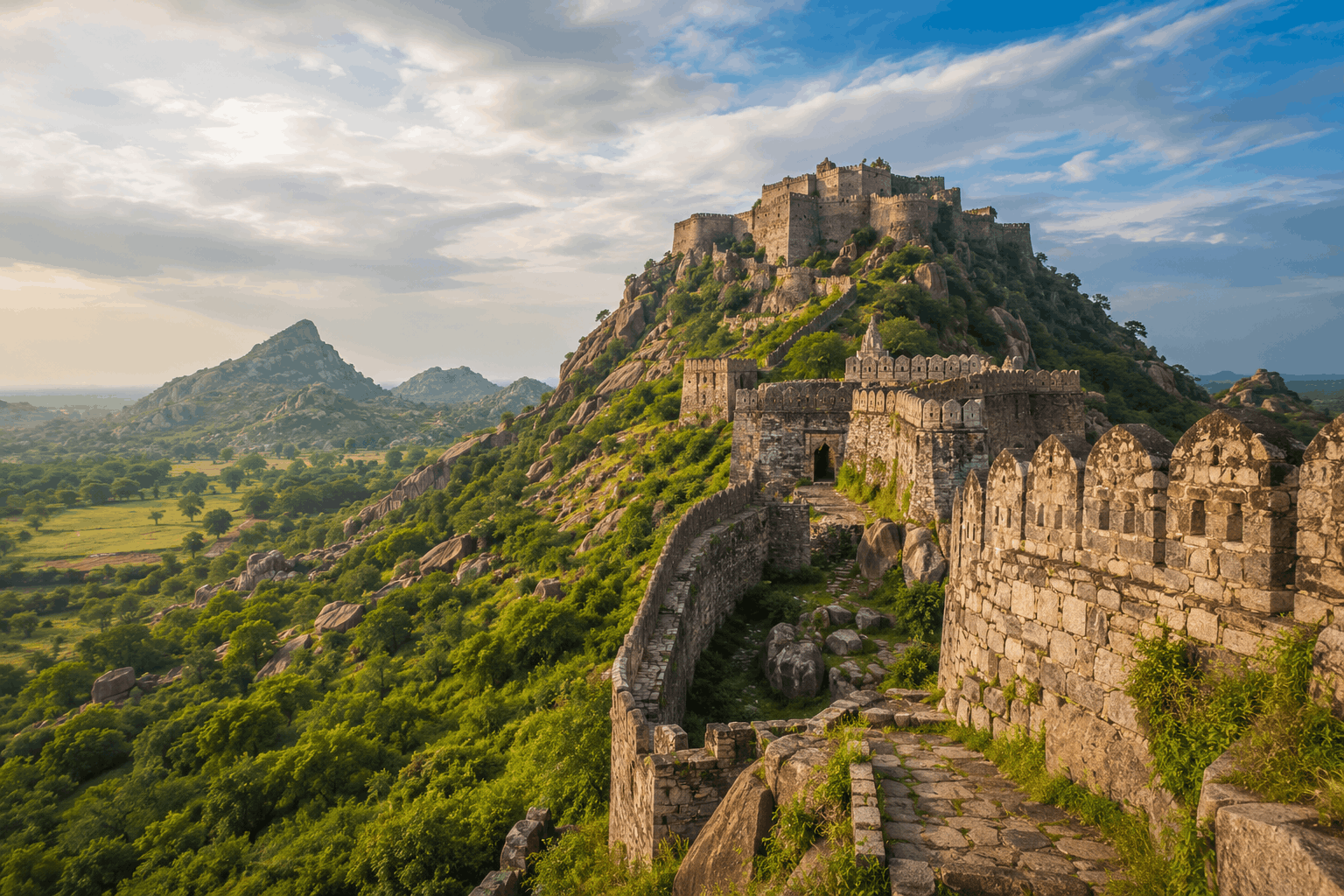
The British called Gingee Fort “the Troy of the East.” Shivaji Maharaj, after capturing it in 1677, called it “the most impregnable fortress in India.” Both descriptions make complete sense once you see the terrain.
The fort complex spans three separate hilltops: Rajagiri to the west (the highest), Krishnagiri to the north, and Chakkilidrug to the southeast. The main road between Pondicherry and Tiruvannamalai runs directly through the complex. Originally built by the Chola dynasty in the 9th century, the fort was expanded over eight centuries by the Vijayanagara empire, Bijapur Nawabs, Marathas, French (1750 to 1761), and British.
Gingee is not well-known as a destination despite its scale. On most weekdays it is almost empty.
What to do at Gingee Fort:
- Trek to Krishnagiri Hill (45 to 60 minutes up, accessible route, good views)
- Attempt Rajagiri Hill (90 minutes up, steepest, most dramatic; carry water and wear grip shoes)
- Explore the Kalyana Mahal, a pyramidal tower, the most photographed structure inside the complex
- Visit the Ranganatha temple, granaries, stables, and Aanaikulam (sacred pond) inside the fort walls
Entry fee: Rs 20 for Indian nationals, Rs 250 for foreign nationals. Maintained by the Archaeological Survey of India.
Timings: 9 AM to 5 PM daily. Hill entry closes at 3 PM. Do not arrive after noon if you want to climb.
Best time: October to March. Avoid peak summer (April to June) when the climb becomes very hot.
Getting there: Take the Chennai to Pondicherry bus on zingbus (195 km ECR route, 3 to 4 hours). Gingee is 70 km from Pondicherry, making it an easy stop en route. State buses also run from Chennai Koyambedu directly to Gingee town; the fort is 2 km from the bus stand.
Best for: History enthusiasts, trekkers, photographers, and anyone who wants a ruined fort experience with very few other visitors.
Yelagiri Hills (165 km from Chennai)
Distance from Chennai: Approximately 165 km via Vellore on NH44, Tirupattur district
Yelagiri sits in the Javadi Hills at an elevation of 1,100 to 1,410 metres, spread across a plateau holding 14 villages. Unlike Ooty or Kodaikanal, Yelagiri has not been developed around tourism. There are no cable cars, no major commercial parks, and no crowded vendor lanes near the viewpoints. On most weekdays, the plateau is genuinely quiet.
What to do at Yelagiri:
- Walk to Jalagamparai Waterfall, about 5 km from the main market area through light forest; best from July to September
- Boating on Punganoor Lake at the centre of the plateau
- Trek to Swamimalai Hills for panoramic views of the valley below
- Seasonal paragliding from the meadow ridge (October to May)
Best time: October to March for pleasant temperatures; July to September for the waterfall at full flow.
Getting there: Take the Chennai to Vellore bus on zingbus (162 km, approximately 3 hours, from Rs 560). From Vellore, Yelagiri is approximately 55 km further by local transport via Jolarpet. Book the Chennai to Vellore bus at least 3 days in advance for weekends.
Avoid: The Sunday afternoon return journey on the Jolarpet to Yelagiri ghat road. Weekend traffic on this section backs up significantly.
Best for: Families wanting a quiet hill experience, solo travellers who prefer a hill station without the crowds, and anyone who has seen Ooty and wants something calmer.
Longer Drives Worth Making: 200 km and Beyond
Both destinations below require a weekend, not just a day. Both deliver something that cannot be experienced at any other destination near Chennai.
Pichavaram Mangrove Forest (240 km from Chennai)
Distance from Chennai: Approximately 240 km via ECR or NH45 toward Chidambaram, Cuddalore district
Pichavaram is one of the largest mangrove ecosystems in India, covering approximately 1,100 hectares. The experience is fundamentally different from anything else on this list: a flat-bottomed boat moving through narrow channels with mangrove roots closing in on both sides, the sound of the open road completely replaced by water and birds.
The boat network covers a series of channels that vary from wide open lagoon to tight forest corridors. The narrower inland channels are the ones worth spending time in. The journey through them is silent except for water movement and birds.
What to do at Pichavaram:
- Take a paddle boat (approximately Rs 150 per hour) through the narrower channels for the closest mangrove experience
- Take a motorboat (approximately Rs 1,000 per hour) for a broader circuit covering more ground
- Birdwatch in the morning within the forest channels (cormorants, egrets, and kingfishers are common)
- Combine with the Nataraja Temple at Chidambaram (5 km from Pichavaram), a 40-acre Chola-era complex dedicated to Shiva as the lord of dance
Timings: 9 AM to 6 PM daily.
Best time: October to February for calm water and birdwatching; July to September for lush green monsoon mangrove experience.
Getting there: TNSTC buses run from Chennai Koyambedu to Chidambaram (approximately 4.5 to 5 hours). From Chidambaram, Pichavaram is 15 to 20 minutes by autorickshaw.
Recommended plan: Day 1 visit Chidambaram’s Nataraja Temple in the morning, boat ride at Pichavaram in the afternoon. Stay overnight in Chidambaram and return the next day.
Best for: Nature lovers, couples, photographers, and anyone who wants complete quiet in a natural setting.
Tranquebar / Tharangambadi (280 km from Chennai)
Distance from Chennai: Approximately 270 to 283 km via ECR and NH45, Mayiladuthurai district
Tranquebar’s Tamil name, Tharangambadi, means “the shore where the waves sing.” The name is accurate and the town deserves the description.
In November 1620, Danish Admiral Ove Gjedde struck a deal with Raghunatha Nayak of Tanjore for a piece of coastal land, paying Rs 3,000 per year in tribute. The Danes built Fort Dansborg that same year directly on the beach. It is the second largest Danish fort ever constructed, after Kronborg Castle in Denmark, which is the setting of Shakespeare’s Hamlet.
The town remained a Danish colony for 225 years, until 1845 when Denmark sold it to the British East India Company. During that period, Bartholomaeus Ziegenbalg, a German missionary sent by the Danish king in 1706, learned Tamil and translated the Bible into it. Tamil became the first Indian language in which the complete Bible was printed. The Zion Church, built in 1701, is India’s oldest Protestant church, still standing and still active.
Tharangambadi today is a quiet Tamil Nadu fishing town. Walking through the heritage zone takes a morning. The fort museum is worth an hour. The beach in front of the fort is clean and almost always empty.
What to do at Tranquebar:
- Explore Fort Dansborg and its museum (open 10 AM to 5 PM, nominal entry fee)
- Visit the Zion Church (1701) and the New Jerusalem Church (1718)
- Walk Goldsmith Street, restored by the Indo-Danish Heritage Foundation
- Sit on the beach in front of the fort at sunrise or sunset
- Combine with Karaikal (15 km away) and the Nagapattinam coast
Best time: October to March; avoid during cyclone season (October to December can be rough on the coast).
Getting there: TNSTC buses from Chennai to Mayiladuthurai (approximately 6 to 7 hours), then a local bus or auto to Tharangambadi (24 km). Best approached as an overnight trip; stay in Karaikal or Mayiladuthurai to explore the area across two days.
Best for: History enthusiasts, heritage travellers, quiet beach seekers, and anyone fascinated by colonial-era India.
Smart Combinations: Two Places in One Trip
Pairing destinations that are close to each other makes a more complete trip without adding much travel time.
- Pulicat Lake and Nagalapuram: Both are north of Chennai within 100 km. Drive up on a Saturday morning, visit Pulicat, continue to Nagalapuram for the evening and overnight camping, trek on Sunday morning.
- Uthiramerur and Vedanthangal: Both are via Chengalpattu and can be covered in a single long day from Chennai, with Uthiramerur in the morning and Vedanthangal in the afternoon during November to February.
- Gingee Fort and Tiruvannamalai: Gingee is 40 km from Tiruvannamalai, which holds the Arunachaleswara Temple complex (one of the largest temple complexes in India). A good two-day heritage circuit.
- Pichavaram and Chidambaram: Already essentially one destination. Cover both in a 1-night, 2-day plan.
- Tranquebar and Karaikal: Both are in the Nagapattinam coastal district, 15 km apart. Worth combining into a full coastal heritage loop.
How to Get There from Chennai
For intercity connections from Chennai to the nearest hub towns for these destinations:
- Pondicherry direction (for Gingee, Pichavaram, Tranquebar): Take the Chennai to Pondicherry bus on zingbus, 195 km via ECR, approximately 3 to 4 hours.
- Vellore direction (for Yelagiri): Take the Chennai to Vellore bus on zingbus, 162 km, approximately 3 hours, from Rs 560.
- Within 100 km (Pulicat, Nagalapuram, Uthiramerur, Vedanthangal): TNSTC state buses or a self-drive vehicle are the most practical options. No zingbus routes serve these short-distance points directly.
Book intercity buses at least 5 days in advance for Friday and Saturday departures between October and March, when demand on the Pondicherry and Vellore corridors rises significantly.
You Might Also Like
- Places to Visit Near Chennai Under 300 km: A broader guide to destinations within the 300 km radius with bus route planning details.
- Chennai to Pondicherry Trip by Bus: Route, Cost and Guide: The ECR route guide that also connects to Gingee Fort and the southern coast.
- Chennai to Coimbatore by Bus: Route, Fare and Travel Guide 2026: For those extending a Tamil Nadu trip toward the Nilgiris after these coastal and hill destinations.
Quick Travel Tips
- Most of these destinations are significantly quieter on weekdays. Gingee Fort and Uthiramerur in particular see far fewer visitors from Tuesday to Thursday than on weekends.
- Carry cash. Several destinations including Vedanthangal, Pichavaram, and Gingee have limited ATM access or card infrastructure nearby.
- At Gingee Fort, hill entry closes at 3 PM regardless of the fort’s general closing time. Arrive by 10 AM if you want to attempt Rajagiri, the highest citadel.
- For Vedanthangal and Pulicat, the November to February window is specifically when migratory bird populations peak. A visit outside this window still shows the site but not the nesting season.
- Pichavaram boat fares are posted at the TEDA counter inside the entry gate. These are the official rates. Ignore any operators offering rides outside the main gate.
- At Tranquebar, the town is small enough to walk entirely. Skip hiring a vehicle inside the heritage zone.
- The Yelagiri ghat road between Jolarpet and the plateau is narrow and slow. Sunday afternoon return traffic backs up on this stretch. Leave the plateau before 2 PM if driving back to Chennai.
- Nagalapuram is best as a guided trek or with a group that has done the route before. Carry at least 2 litres of water per person and inform someone of your route before starting.
Chennai Has More Than One Direction Worth Taking
The offbeat places near Chennai in this guide cover directions and distances that the usual weekend list ignores entirely. Pulicat Lake is an hour away and holds a Dutch fort from 1613. Uthiramerur is 90 km away and holds stone records of a democratic election from 920 AD. Tranquebar is 280 km away and carries 225 years of Danish colonial history in a town that barely sees 200 visitors a week.
None of these require any particular preparation, specialist knowledge, or tolerance for discomfort. They require a confirmed plan, a bus ticket, and the decision to go somewhere that has not been turned into a weekend package deal. Most of them will reward you more specifically than a standard Pondicherry trip, and none of them will feel crowded when you get there.
Frequently Asked Questions
What are the best offbeat places near Chennai for a quiet getaway?
The best offbeat places near Chennai include Pulicat Lake (60 km), Nagalapuram (90 km), Uthiramerur (90 km), Vedanthangal (100 km), Gingee Fort (160 km), Yelagiri (165 km), Pichavaram (240 km) and Tranquebar (280 km).
Which offbeat places near Chennai can be visited as a day trip?
Pulicat Lake, Nagalapuram, Uthiramerur, and Vedanthangal are all within 100 km and suitable for day trips from Chennai with an early morning start.
What is special about Uthiramerur near Chennai?
Uthiramerur holds stone inscriptions dated 918 to 921 AD recording the Kudavolai system, a ballot-based democratic electoral process used during the Chola dynasty, making it one of the earliest documented democratic systems in the world.
Is Gingee Fort worth visiting from Chennai?
Yes. Gingee Fort is 160 km from Chennai, has an entry fee of Rs 20 for Indians, and spans three hilltop citadels that Shivaji called the most impregnable fortress in India and the British called the Troy of the East.
What is Tranquebar famous for?
Tranquebar, officially Tharangambadi, is home to Fort Dansborg (built 1620), the second largest Danish fort in the world, and the Zion Church (1701), India’s oldest Protestant church.
How do I reach Yelagiri from Chennai?
Take the Chennai to Vellore bus on zingbus (162 km, approximately 3 hours, from Rs 560), then take local transport from Vellore to Yelagiri (55 km via Jolarpet).
What is the best time to visit offbeat places near Chennai?
October to March is comfortable for all eight destinations; Vedanthangal and Pulicat Lake specifically reward a November to February visit for migratory bird season, and Jalagamparai Falls at Yelagiri is best from July to September.
Is Pichavaram a mangrove forest near Chennai?
Yes. Pichavaram is one of India’s largest mangrove ecosystems, approximately 240 km from Chennai near Chidambaram, covering 1,100 hectares and offering paddle boat and motorboat rides through the forest channels.
Which offbeat destination near Chennai is best for a solo traveller?
Uthiramerur (heritage, easy access), Vedanthangal (birdwatching, compact site), and Tranquebar (walkable colonial town, quiet beach) are all well-suited for solo travellers who prefer quiet, self-directed exploration.
Can I combine multiple offbeat destinations near Chennai in one trip?
Yes. Uthiramerur and Vedanthangal work together in a single day via Chengalpattu. Gingee Fort pairs naturally with Tiruvannamalai. Pichavaram and Chidambaram are best covered together over one night.