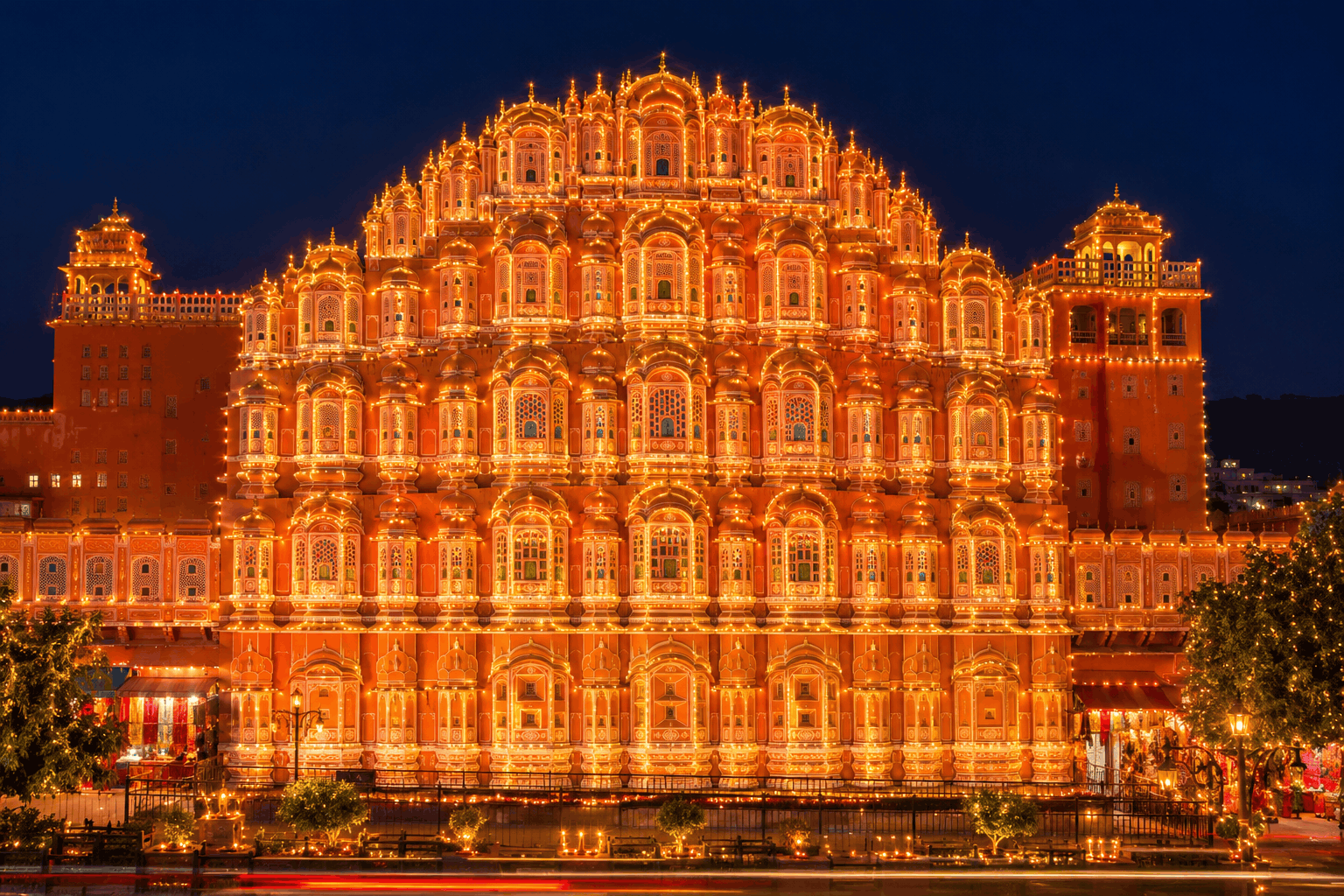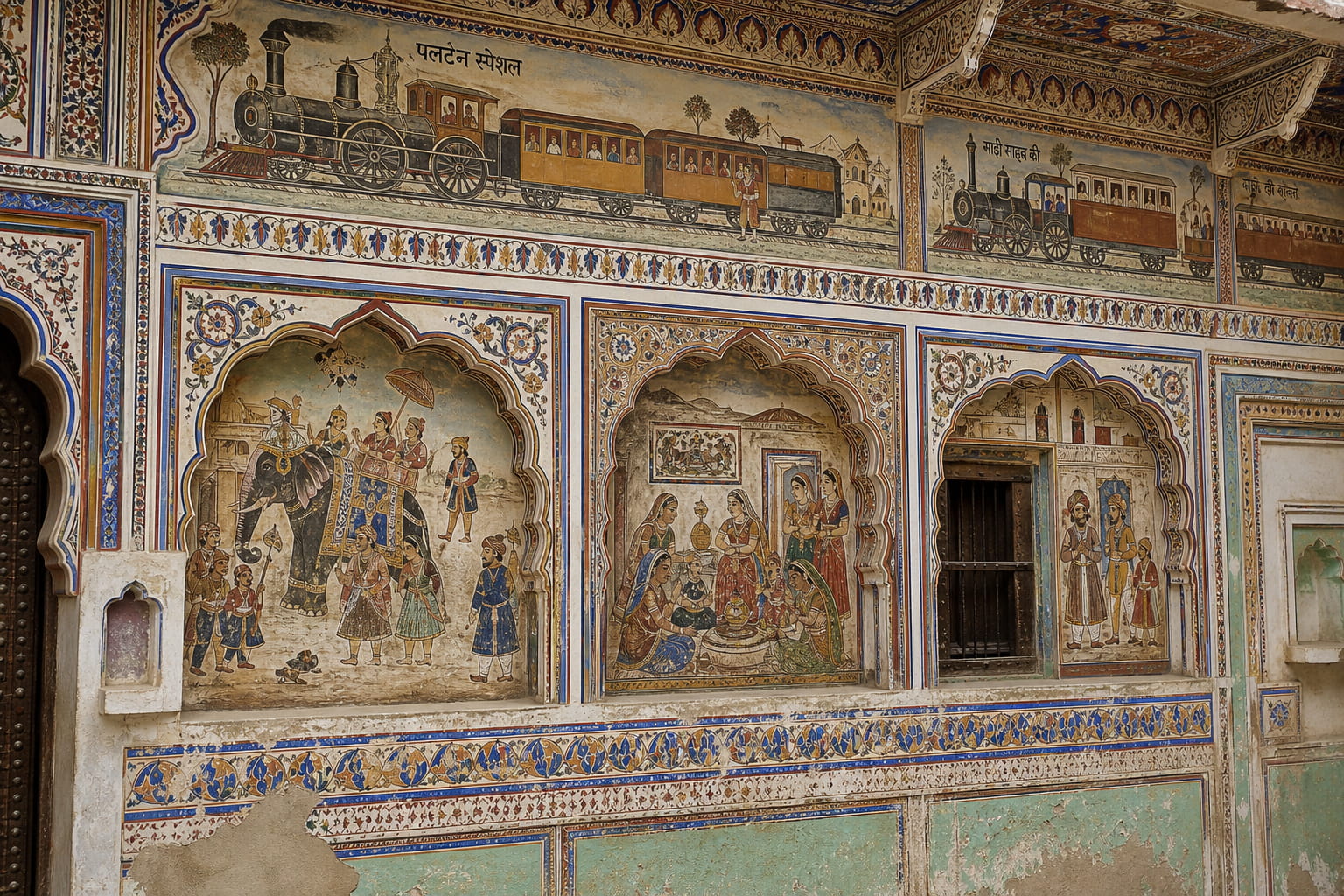
The standard weekend itinerary from Delhi runs through a well-worn circuit. Agra for the Taj Mahal, Jaipur for the palaces, Rishikesh for the river and yoga. These are legitimate choices and they are popular for good reasons. But within three to four hours of Delhi by bus, there are destinations that most travellers in the city have never visited and some have never heard of: an abandoned Rajput town that the Archaeological Survey of India maintains and keeps locked after sunset, a region where 18th-century Marwari merchants painted aeroplanes and steam locomotives on their haveli walls, and an English-language author’s village so quiet that it has only four shops.
Offbeat Places Near Delhi by Bus: A Complete Overview
This guide covers seven genuinely offbeat places near Delhi reachable by bus, organized by distance from the city. Each destination has a specific anchor fact that makes it worth visiting on its own merits, not just because it happens to be close to Delhi. Distances range from 165 km to 280 km, and all seven can be reached with a combination of an intercity bus from Delhi and local transport at the destination end.
Check zingbus Delhi bus routes for schedules and AC bus options on the key corridors connecting Delhi to these destination hubs.
Offbeat Places Near Delhi by Bus: 7 Hidden Destinations Most Travellers Miss
These places share one characteristic: they are genuinely offbeat, not simply less visited. Each one has a character and a reason to go that cannot be replicated elsewhere near Delhi.
Quick Reference: All 7 Offbeat Places Near Delhi
| Destination | Distance | Category | Ideal Duration |
| Bhangarh Fort, Alwar | 165 km | Heritage ruins, history | Day trip |
| Kurukshetra | 170 km | Historical, spiritual | Day trip |
| Sariska Tiger Reserve | 200 km | Wildlife, nature | Weekend |
| Lansdowne | 233 km | Hill town, heritage | Weekend |
| Shekhawati | 250 to 280 km | Fresco heritage, art | Weekend |
| Landour | 280 km | Hill village, literary | Weekend |
| Morni Hills | 280 km | Nature, lake, Haryana | Day trip or weekend |
Day Trips Under 200 km from Delhi
These three destinations are within three to four hours of Delhi by road, making them realistic as long day trips or comfortable one-night stays.
Bhangarh Fort and Alwar Region (165 km from Delhi)
Distance from Delhi: 165 km, Alwar district, Rajasthan
The Bhangarh Fort complex covers approximately 4.7 square kilometres and contains the ruins of a complete abandoned town: palaces, bazaars, temples, haveli streets, and gateways, all in various states of preservation. The fort was built in the early 17th century and the town was inhabited for several generations before being abandoned. The Archaeological Survey of India maintains the site and it is one of the most completely preserved examples of a medieval Rajput town in northern India.
The popular mythology around Bhangarh, which calls it one of India’s most haunted places, is based on a curse legend involving Guru Balu Nath, a sadhu whose meditation spot was allegedly overshadowed by the fort’s expanding shadow. The actual ruins are remarkable on their own terms, independent of the ghost stories. Walking through the bazaar streets, the temple complex, and the palace ruins with the Aravalli Hills rising behind the fort gives the site a cinematic quality that makes it worth visiting for architectural and historical interest alone.
What to do at Bhangarh:
- Walk through the main bazaar approach toward the palace complex, where 360 shops once lined the entry road.
- Explore the Gopinath Temple at the bazaar entry, the Mangla Devi Temple, and the Someshwar Mahadev temple inside the complex.
- Photograph the palace ruins from the hilltop behind the complex for the full scale perspective.
- Combined with Sariska Tiger Reserve (30 km from Bhangarh) and Siliserh Lake Palace (near Alwar town) for a complete Alwar district day.
Best time: October to March. The monsoon season (July to September) makes the ruins slippery but also turns the Aravallis behind the fort unusually green.
Getting there: Bus from Delhi to Alwar (approximately 2.5 to 3 hours on the Delhi-Jaipur corridor), then local auto-rickshaw or taxi to Bhangarh (approximately 65 km from Alwar town). Direct buses from Delhi also run to Dausa (closest railway station to Bhangarh, approximately 22 km).
Kurukshetra: The Mahabharata Battlefield (170 km from Delhi)
Distance from Delhi: 170 km via NH44, Haryana
Kurukshetra is where the 18-day Mahabharata war is recorded as having taken place. The historical site spans a wide area of Haryana, with over 48 kos (approximately 150 km) parikrama holy sites spread across the region. What most travellers miss is that Kurukshetra today holds several specific experiences that are rarely communicated alongside the location’s name.
The Brahma Sarovar is one of the largest sacred tanks in India, covering an area of approximately 3.5 square kilometres. The sacred tank at its centre and the temple island visible from the ghats create a genuinely large-scale religious landscape that surprises most first-time visitors.
The Kurukshetra Panorama and Science Centre contains a 360-degree circular panoramic painting of the Mahabharata battle that visitors walk through from the inside. The scale of the painting, which depicts the battlefield action at the moment of Krishna’s Vishwaroop darshan to Arjuna, is the largest continuously illustrated scene from the Mahabharata anywhere in India.
The Sri Krishna Museum houses artefacts, manuscripts, and artistic interpretations of Krishna’s life and the Mahabharata across multiple galleries.
Best time: October to March. Visit during the solar eclipse period (Surya Grahan), when Kurukshetra draws pilgrims from across India in exceptional numbers, if you want the maximum pilgrimage atmosphere.
Getting there: Frequent buses and trains from Delhi to Kurukshetra (Ambala direction). Bus journey approximately 3 to 3.5 hours.
Sariska Tiger Reserve (200 km from Delhi)
Distance from Delhi: Approximately 200 km, Alwar district, Rajasthan
Sariska is the tiger reserve closest to Delhi and, relative to Ranthambore, is significantly less crowded. The reserve covers 866 square kilometres of the Aravalli Hills and holds a tiger population reintroduced after the late 2000s. Leopards, jungle cats, striped hyenas, sambar deer, nilgai, and wild boar are more reliably sighted than tigers, though tiger sightings are not uncommon.
What makes Sariska offbeat relative to Ranthambore is the absence of the premium safari camp ecosystem that has built up around the more famous reserve. Sariska’s infrastructure is simpler, the guides less commercialised, and the morning drives through the Aravalli scrub forest have a roughness that more developed wildlife destinations have lost.
The ruins of Kankwari Fort within the reserve , where Aurangzeb imprisoned his brother Dara Shikoh before his execution, add a historical layer unusual in a tiger reserve setting.
Best time: November to March for wildlife sightings; the reserve is closed in summer (roughly April to June) and partially during monsoon.
Getting there: Bus from Delhi to Alwar, then local transport to the Sariska reserve gate (approximately 37 km from Alwar).
A Step Further: 200 to 300 km from Delhi
These four destinations are best approached as weekend stays. All four are distinct enough to reward two days rather than a rushed day trip.
Lansdowne: The Garhwal Rifles Cantonment (233 km from Delhi)
Distance from Delhi: 233 km via Kotdwar, Pauri Garhwal district, Uttarakhand
Lansdowne was established in 1887 by Lord Lansdowne, then Viceroy of India, as a hill cantonment for the Garhwal Rifles regiment of the British Indian Army. The original name was Kalundanda; the British renamed it after the Viceroy. Today it remains the regimental headquarters of the Garhwal Rifles and is one of the few hill stations in India where active military use has preserved the original cantonment character without commercial development replacing it.
The specifics that make Lansdowne worth visiting: the Garhwal Rifles War Memorial and Museum holds artefacts and histories from the regiment’s campaigns going back to 1887 and through both World Wars. The Bhim Pakora is a naturally balanced pair of large boulders, sitting balanced on each other in a manner that visitors can test by pushing from the side (they shift slightly without falling). The Tip-In-Top viewpoint at the cantonment ridge gives a clear panorama of the Garhwal Himalayan range on clear winter mornings.
At 1,706 metres, Lansdowne is not the highest hill town near Delhi but is consistently described as the most preserved in terms of original character. Dense oak and pine forest, colonial-era churches, and the near-absence of commercial tourism combine into something genuinely quieter than the hill stations most Delhi weekenders know.
What to do:
- Bhulla Tal lake: paddleboating and a walking trail around the lake edge.
- Jungle Safari to Kalagarh Tiger Reserve (30 km from Lansdowne).
- Tarkeshwar Mahadev Temple (36 km from Lansdowne), a significant Shiva temple in Garhwal.
- Walk the cantonment lanes at dawn, when the Himalayan view from the ridge is clearest.
Best time: October to June. Monsoon makes the approach road from Kotdwar difficult.
Getting there: Bus from Delhi to Kotdwar (approximately 260 km, 6 to 7 hours), then local taxi or shared jeep to Lansdowne (40 km, 1 hour).
Shekhawati: The Open-Air Fresco Art Gallery of Rajasthan (250 to 280 km from Delhi)
Distance from Delhi: Approximately 250 to 280 km via Sikar or Jhunjhunu, Rajasthan
Shekhawati is the name for the sub-region of northern Rajasthan where wealthy Marwari merchant families built elaborate havelis between the 18th and 20th centuries. The havelis are covered in frescos, floor to ceiling and including ceilings, doorways, and outer courtyard walls.
The specific quality of Shekhawati’s frescos that sets them apart is their subject matter. Marwari merchants in the 19th century had heard descriptions of technological inventions they had never seen, steam locomotives, aeroplanes, gramophones, telephones, automobiles, from traders passing through. Their artists painted these subjects on the haveli walls based on verbal descriptions. The result is a series of visual interpretations of modernity painted by people who had no visual reference for what they were depicting. The aircraft painted on the walls of Nawalgarh havelis is identifiable as an aeroplane but looks like no specific aeroplane ever built. This particular quality makes the Shekhawati frescos historically and aesthetically remarkable beyond their decorative value.
French art historian Francis Wacziarg called the region the “open-air art gallery of Rajasthan” and this description has stayed. Nawalgarh alone has over 35 painted havelis. The towns of Mandawa, Dundlod, Fatehpur, Ramgarh, and Jhunjhunu each have their own significant painted properties.
What to do:
- Base yourself in Nawalgarh or Mandawa and walk between havelis over two days.
- The Aath Haveli, Morarka Haveli, and Bhagton Ki Choti Haveli in Nawalgarh are the most accessible for visitors.
- Local cycle-rickshaw rides between havelis is the traditional way to cover the town.
- The Dundlod Fort (now a heritage hotel) in Dundlod and the Mandawa Castle both allow visitors.
Best time: October to March.
Getting there: Bus from Delhi to Sikar (approximately 250 km, 5 hours), then local buses or shared taxis to Nawalgarh or Mandawa.
Landour: Ruskin Bond’s Village Above Mussoorie (280 km from Delhi)
Distance from Delhi: Approximately 280 km via Dehradun and Mussoorie, Tehri Garhwal district, Uttarakhand
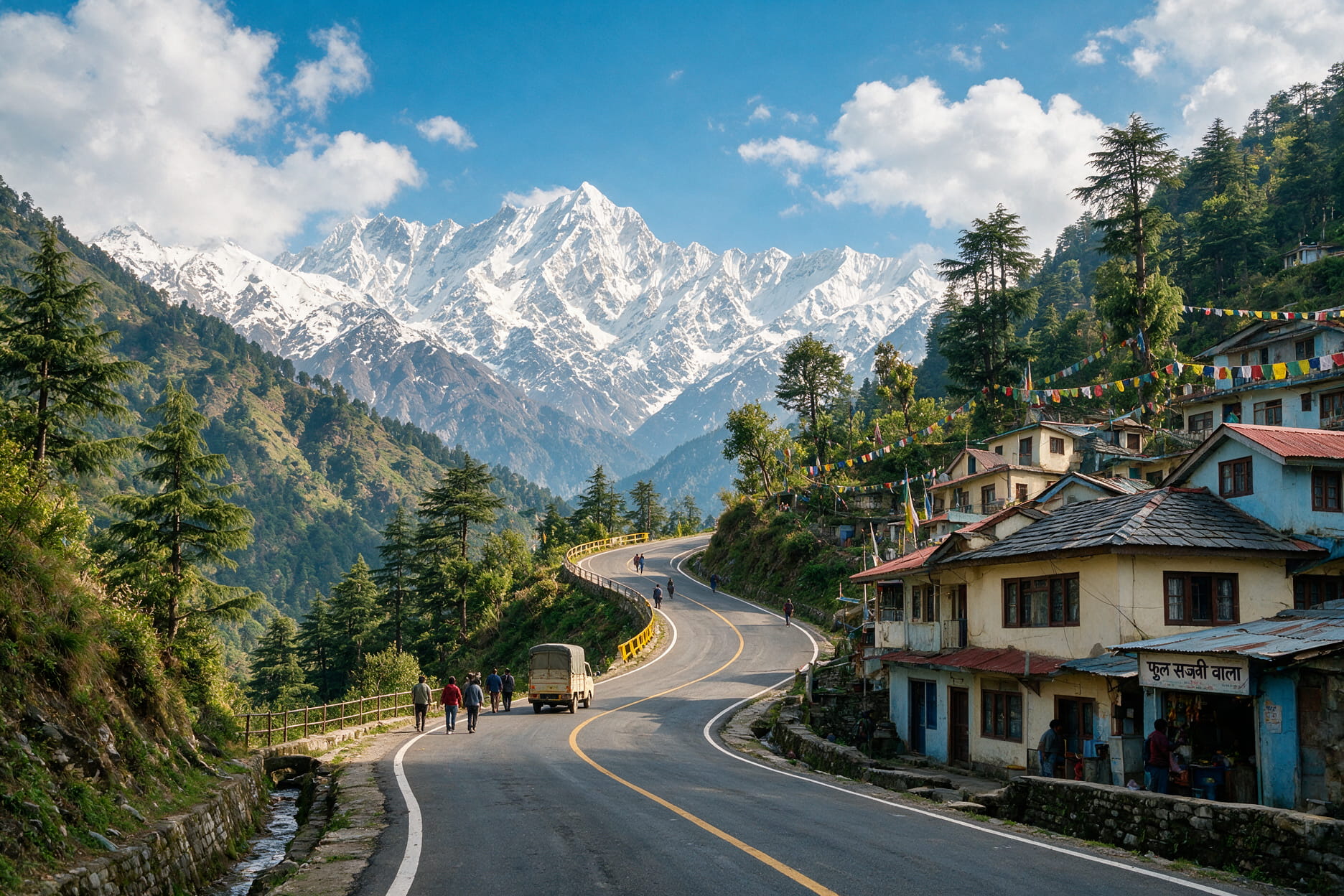
Landour sits 5 km above Mussoorie’s Mall Road by a winding uphill road. Despite this small distance, the crowd difference between Mussoorie and Landour is enormous. Mussoorie’s Mall Road has the traffic, the vendors, the cable cars, and the weekend holiday density. Landour is the 19th-century British cantonment above it: deodar trees, stone cottages, a handful of small establishments, and very few visitors.
The reason Landour appears in the cultural consciousness of English-language India is Ruskin Bond, who has lived here for most of his adult life. The author of “The Room on the Roof,” “A Flight of Pigeons,” “Our Trees Still Grow in Dehra,” and dozens of collections set in the Garhwal hills lives in Landour and is occasionally visible at the Char Dukan, literally “four shops”, a cluster of four establishments at the top of the Landour lane that includes a cafe, a snack shop, and a bakery. Bond has written about these four shops more times than any building in his work.
The Kellogg Memorial Church, built in 1903, the Landour Language School, and the old cantonment cemetery add to a landscape that feels genuinely 19th century in character.
What to do:
- Walk the circular Char Dukan loop and the Lal Tibba approach road for Himalayan views (Lal Tibba is the highest point in the Mussoorie-Landour area at 2,275 metres).
- Visit Char Dukan in the morning; Anil’s Cafe within the cluster is the establishment most associated with Bond’s essays about the area.
- The Woodstock School at Landour has a small chapel and gardens that are occasionally open to visitors.
- The view from the Landour ridge toward the Shivalik ranges on clear winter mornings is one of the better Himalayan ridge views accessible by road near Delhi.
Best time: October to June.
Getting there: Take the Delhi to Mussoorie bus on zingbus (approximately 286 km, 6 hours), then a local taxi or walk uphill 5 km from Mussoorie’s Library Chowk to reach Landour.
Morni Hills: Haryana’s Only Hill Station (280 km from Delhi)
Distance from Delhi: Approximately 280 km via Chandigarh, Panchkula district, Haryana
Morni Hills is the only hill station in Haryana and one of the least visited within 300 km of Delhi. At approximately 1,220 metres, it is not a high-altitude destination, but the Shivalik range setting, the two glacial lakes (Tikkar Taal), and the near-complete absence of commercial tourism give it a specific character that the more developed Himachal Pradesh hill stations do not have.
The Tikkar Taal complex, managed by Chandigarh Tourism, consists of two lakes connected by a short path with paddle boating and a cafeteria. The Morni Fort ruins above the village are accessible by a 40-minute walk and give a view across the Shivalik range and down toward the Chandigarh plain.
The most significant thing about Morni Hills for a weekend from Delhi is what it does not have: no cable cars, no toy trains, no crowd-oriented markets, no resort strips. It is a Haryana hill village that has attracted minimal development and consequently rewards visitors looking for exactly that quality.
Best time: October to March. Monsoon makes the road approach from Chandigarh slippery.
Getting there: Bus from Delhi to Chandigarh (approximately 240 km, 5 hours), then local taxi to Morni Hills (approximately 45 km from Chandigarh, 1.5 hours).
Smart Combinations for One Trip
The proximity of several destinations to each other makes some combinations practical.
- Bhangarh and Sariska: Both are in Alwar district, 30 km apart. Bhangarh in the morning, Sariska safari in the afternoon and the following morning, covering both in a 1-night, 2-day Alwar trip.
- Kurukshetra and Morni Hills: Both are northwest of Delhi via NH44 and the Chandigarh direction. A weekend covering Kurukshetra on day 1 (3 hours from Delhi) and Morni Hills on day 2 (via Chandigarh, 45 km from the city) makes geographic sense.
- Shekhawati and Jaipur: Shekhawati is on the way to Jaipur from Delhi. A trip to Nawalgarh or Mandawa extends the Jaipur weekend into the Shekhawati circuit by adding one extra day at the start.
- Mussoorie and Landour: These are the same destination with a 5 km altitude difference. A Mussoorie weekend that includes two hours at Char Dukan and the Landour ridge walk is the most complete version of what that hill station area offers.
Getting There from Delhi by Bus
The zingbus Delhi bus page covers the key corridors: Delhi to Mussoorie (6 hours) for Landour, Delhi to Jaipur direction for Alwar and Shekhawati, and Delhi to Chandigarh for Morni Hills. For Lansdowne, the key junction is Kotdwar, reached from Delhi’s Kashmere Gate bus terminal.
For destinations requiring a change at an intermediate town (Alwar for Bhangarh and Sariska, Kotdwar for Lansdowne, Chandigarh for Morni Hills, Sikar for Shekhawati), allow 1 to 1.5 hours for the onward local leg.
You Might Also Like
- Best Honeymoon Destinations from Delhi by Bus: For couples who want Delhi-originating bus journeys to romantic destinations rather than the offbeat circuit.
- Hidden and Unexplored Places in India 2026: Pan-India coverage of genuinely lesser-known destinations beyond the usual shortlist.
- How to Plan a Road Trip in India: For travellers planning to combine multiple of these destinations into one multi-stop trip from Delhi.
Planning Tips for Offbeat Delhi Destinations
- For Bhangarh, the entry to the site is free and the ASI gates open at sunrise. Arriving at 7 to 8 AM on a weekday means walking through the ruins with very few other visitors.
- Shekhawati havelis are private property; some charge entry fees ranging from Rs 50 to Rs 200. The best way to navigate is to engage a local guide in Nawalgarh rather than entering every haveli independently.
- Landour’s Char Dukan is busiest on weekend afternoons. Visiting on a weekday morning gives the quietest version of the area.
- Lansdowne’s cantonment restrictions mean some areas require prior permission. Stick to the civilian zones and the open areas around Bhulla Tal, Tip-In-Top, and the war memorial for a full day.
- Morni Hills has limited accommodation. The Haryana Tourism rest house requires advance booking; private guesthouses in the village are basic but functional.
- For Kurukshetra, avoid visiting on the day of a solar eclipse if you want a quiet experience; the site draws pilgrims in the hundreds of thousands during eclipses.
Frequently Asked Questions
These questions reflect what travellers most commonly ask about offbeat places near Delhi by bus.
What are the best offbeat places near Delhi by bus?
The best offbeat places near Delhi by bus include Bhangarh Fort in Alwar (165 km), Kurukshetra (170 km), Lansdowne (233 km), Shekhawati (250 to 280 km), Landour (280 km), and Morni Hills (280 km).
Which offbeat place near Delhi can be visited as a day trip?
Bhangarh Fort, Kurukshetra, and Morni Hills are all within 280 km of Delhi and can be managed as long day trips with an early start, though an overnight stay improves each of these significantly.
What is special about Bhangarh Fort near Delhi?
Bhangarh Fort is a 17th-century abandoned Rajput town covering 4.7 square kilometres, maintained by the Archaeological Survey of India, with ruins of palaces, bazaars, and temples that make it one of the most completely preserved medieval ruins in North India.
What is Shekhawati known for?
Shekhawati is known for its 18th and 19th-century havelis painted floor to ceiling with elaborate murals that include depictions of aeroplanes, automobiles, and trains by artists who had never seen these machines firsthand; it is often called the open-air art gallery of Rajasthan.
Who lives in Landour near Mussoorie?
Landour above Mussoorie is the home of Ruskin Bond, India’s celebrated English-language author, who has lived in the cantonment area for most of his adult life and has written extensively about the four-shop cluster known as Char Dukan.
How to reach Lansdowne from Delhi by bus?
Take a bus from Delhi to Kotdwar (approximately 260 km, 6 to 7 hours), then a local taxi or shared vehicle from Kotdwar to Lansdowne (40 km, around 1 hour).
What is Morni Hills?
Morni Hills is the only hill station in Haryana, located 280 km from Delhi near Panchkula, featuring two glacial lakes called Tikkar Taal, forest trails, Shivalik range views, and a complete absence of commercial tourism development.