Beyond Amber and Nahargarh, the places to visit near jaipur under 50 km include a block-printing town that named the Sanganer print tradition, a 16th century Rajput palace at Samode, a dry lake that once held Asian Games rowing events, and Rajasthan’s most significant Sheetla Mata shrine.
This guide covers eight destinations within the strict 50 km range. Sambhar Lake, Bhangarh, and Abhaneri, which are commonly listed as nearby, are 70 to 95 km away and are excluded here. Reach Jaipur by booking your Jaipur bus on zingbus, then organize a day cab from the city.
Places to Visit Near Jaipur Under 50 km
The destinations in this guide cover four distinct categories of experience from within 50 km of the Pink City: the fort ridge that immediately overlooks Jaipur, the craft villages that produce two of Rajasthan’s most distinctive textile traditions, the palace-to-village axis north of the city toward Shekhawati country, and the sacred sites on the city’s southern edge. The places to visit near jaipur under 50 km are more varied in character than the fort-and-bazaar circuit that fills most first-time itineraries.
The Fort Ridge: Amber, Nahargarh, and Jaigarh
These three forts form an arc above and around Jaipur’s northern edge and are the city’s most visited heritage sites. They are included in this guide because they fall within 11 to 15 km of the city center and are frequently overlooked on their own terms by visitors moving through them too quickly.
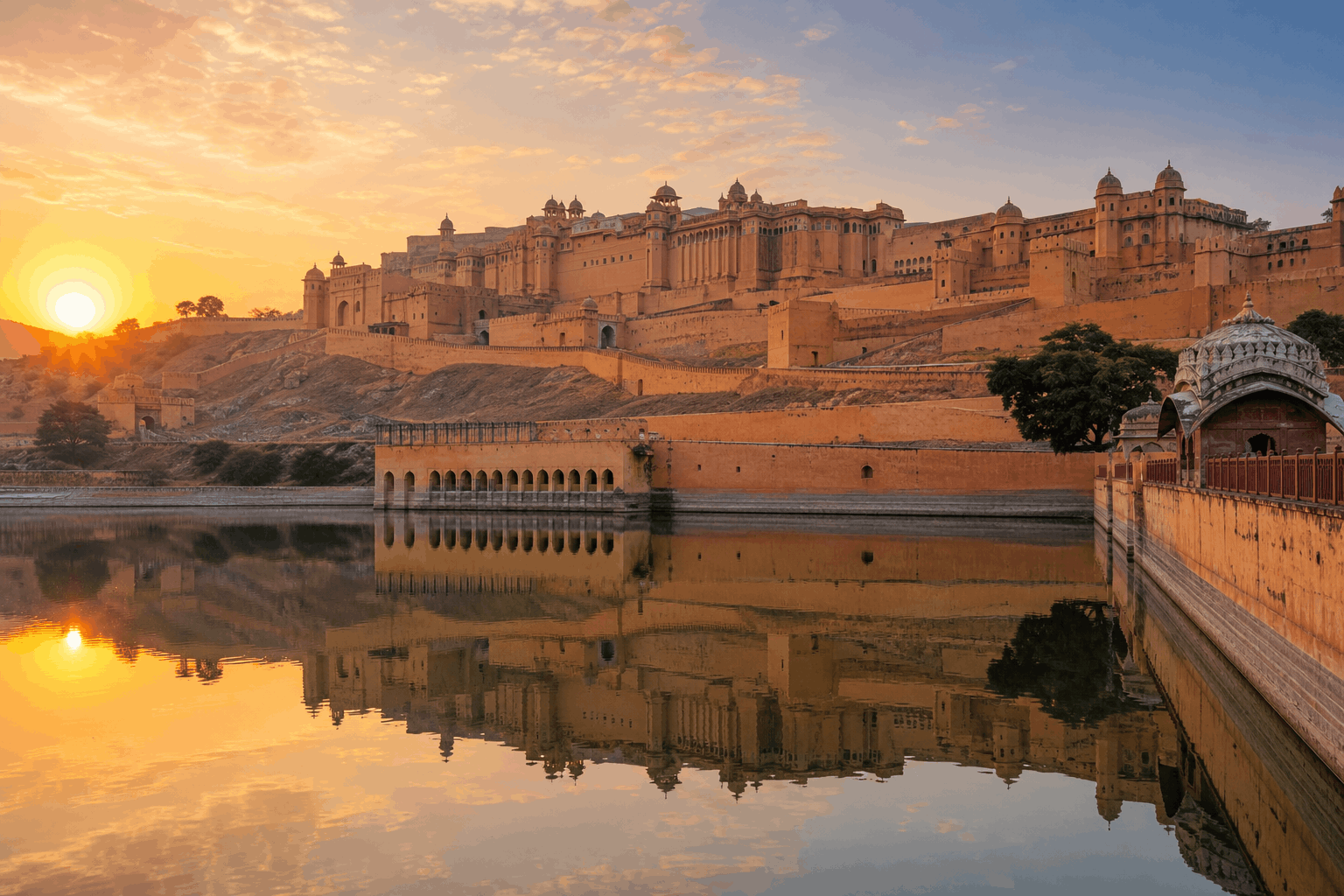
Amber Fort (Amer Fort), 11 km from Jaipur. Built from 1592 by Raja Man Singh I, expanded through successive Kachhwaha rulers, and completed in its current form roughly a century later. The Sheesh Mahal (Hall of Mirrors) in the main palace complex is the most celebrated interior, where thousands of embedded glass pieces in the ceiling and walls create a specific light effect that photographs cannot replicate. The Diwan-e-Aam, Ganesh Pol gateway, and Sukh Niwas with its marble water channels are the other key sections. Elephant rides to the fort entrance are controversial and have faced periodic bans; check current status before planning. Sunrise visits, when the fort is lit before the afternoon crowds, are the best approach for the Maota Lake reflection view.
Nahargarh Fort, 15 km from Jaipur. The perimeter wall fort on the Aravalli ridge is the one that gives Jaipur its most recognizable skyline silhouette. The Madhavendra Bhawan inside, with its 12 identical queens’ suites arranged around a central corridor, is architecturally interesting and often missed by visitors who come only for the city view. The sunset from the Nahargarh rampart is the standard photo in every Jaipur travel feature and it earns the reputation.
Jaigarh Fort, 15 km from Jaipur. Connected to Amber by an underground passage, Jaigarh holds the world’s largest wheeled cannon, the Jai Ban, which has never been fired in combat. The fort also holds the water reservoir system that once supplied Amber and the treasury vaults associated with the Kachhwaha dynasty. Less visited than Amber despite its historical significance.
The Craft Villages: Sanganer and Bagru
Sanganer
Sanganer is 15 to 16 km from Jaipur and is the source of one of India’s most recognized textile printing traditions. Sanganer block prints, characterized by fine floral and bird motifs printed on white or cream cotton grounds with mineral-based colors, have been produced here for at least 500 years. The craft is practiced by the Chhipa community, and the town’s printing quarter along the Saraswati River bank has workshops where visitors can watch the full process: hand-carving the teak blocks, mixing natural mordant dyes, laying the fabric flat, and pressing each block by hand. Direct purchases from workshop cooperatives carry both the authenticity and the better price.
Sanganer is also known for handmade paper production (kagazi kaam) using cotton rags and recycled fabric. The Kagazi Mohalla still has traditional paper artisans producing textured sheets for stationery and art supplies sold across India.
The town also holds the Shri Digambar Jain temple, which carries Dilwara-style carved marble work significant enough to make a separate visit worthwhile.
Sanganer is where Jaipur’s international airport (Jaipur International Airport) is located, which gives a useful orientation point.
Bagru
Bagru is 30 to 35 km from Jaipur on the Jaipur-Ajmer highway and is home to the second of Jaipur’s two major block-printing traditions. Where Sanganer prints are fine and floral on light grounds, Bagru prints use earthier, deeper dyes derived from natural sources on heavier cotton fabric. The Chhipa community in Bagru has maintained the tradition for over 300 years. The Sanjaria River, which historically supplied the water for washing and mordanting, is no longer reliably flowing, but the workshops continue.
The two printing traditions are distinct enough that a single day covering both Sanganer and Bagru gives a more complete picture of Rajasthan’s block-printing heritage than visiting either alone.
Samode: The Palace at the End of the Shekhawati Road
Samode is 39 to 42 km from Jaipur on the road through Chandwaji, turning off the Jaipur-Delhi highway north of Chomu. The Samode Palace is approximately 475 years old, built by the Nathawat family who served as nobles to the Jaipur state. It is not a royal palace of a ruling dynasty but a nobleman’s mansion of exceptional quality.
The Sheesh Mahal, the Durbar Hall, and the Sultan Mahal carry painted interiors in the Shekhawati tradition with European decorative elements introduced in the late 19th century. The property now operates as a heritage hotel, with day visits permitted to the public areas.
Samode Fort, a 300-step climb above the village, gives a view across the Aravalli ridgeline toward Shekhawati. Samode Bagh, a 20-acre Mughal-style garden with a separately bookable accommodation section, sits below the village and is the green counterpoint to the palace’s architectural density.
The village of Samode itself is small and quiet. The drive through Chomu to reach it passes through agricultural land with the characteristic Aravalli escarpment visible on the northern horizon. It is one of the more pleasant short drives from Jaipur in the October to March window.
Ramgarh Lake and Jamwa Ramgarh Wildlife Sanctuary
Ramgarh Lake, 32 to 35 km from Jaipur, was built in 1876 by Maharaja Sawai Ram Singh II as a water supply reservoir for Jaipur. The lake hosted the rowing events of the 1982 Asian Games — the only Olympic-class sporting event ever held in Rajasthan. It has been functionally dry since 1999, which changes the nature of a visit: the lake bed is now grass and scrub, the rowing course long abandoned.
What remains is the Jamwa Ramgarh Wildlife Sanctuary, covering roughly 300 sq km of Aravalli scrub and thorn forest around the former lake basin. The sanctuary holds leopards, jungle cats, nilgai, sambar, and a bird list that makes it a productive birdwatching destination from October through March. The Jamwa Mata Temple on the sanctuary edge is a working pilgrimage site. The Ramgarh Lodge, a former maharaja hunting lodge now operating as a heritage property, occupies the highest point of the area with views across the old lake basin.
For the visitor who expects a lake, Ramgarh is a disappointment. For the one who comes for the Aravalli forest and the wildlife sanctuary, it is one of the more underused reserves this close to a major Indian city.
Chomu: The Gateway Town
Chomu is 29 to 33 km from Jaipur on the road north toward Samode and the Delhi highway junction. The Chomu Palace, owned by the Thakur of Chomu, carries Shekhawati-adjacent painted facades and a small step-well that qualifies it as a day stop. The town’s weekly market serves the surrounding agricultural villages. Chomu is most practically visited as the turning point on the Samode drive rather than a standalone destination, but its small heritage footprint rewards half an hour of walking.
Chaksu: Sheetla Mata and the Fair at the Hill Temple
Chaksu is 40 to 41 km from Jaipur on NH-52 toward Kota, south of the city through Sanganer. The Sheetla Mata temple here sits on a hill called Sheel ki Dungri and is the most significant Sheetla Mata shrine in Rajasthan. The goddess is associated with protection from smallpox and chickenpox; the tradition of offering cold or previously cooked food (called basyoda) is specific to Sheetla Ashtami, which falls in the Chaitra month (March-April).
The Sheetla Ashtami Lakhi fair at Chaksu draws hundreds of thousands of pilgrims in the two days around the festival, making it one of Rajasthan’s largest religious gatherings. On regular visiting days, the temple is quiet and the hilltop gives a clear view of the plains below. The Champeshwar Mahadev shrine and the adjacent Barkhera Jain temple add a second layer of religious heritage to the same visit.
Destinations Commonly Listed But Outside 50 km
For reference, destinations that fall outside the strict 50 km range and should not appear on a within-50 km list:
Sambhar Lake is 70 to 80 km from Jaipur (Wikipedia: 80 km). It is the largest inland salt lake in India and a Ramsar wetland but falls well outside this guide’s range. Bhangarh Fort is approximately 85 km from Jaipur. Abhaneri and the Chand Baori stepwell are approximately 95 km from Jaipur. Dudu is 63 to 74 km. None of these are within 50 km.
Best Season for Jaipur’s 50 km Radius
October through March is the right window for all eight destinations. Rajasthan’s desert climate makes summer (April through June) difficult for outdoor sites. Amber Fort’s climb and the fort ridge at Nahargarh and Jaigarh are uncomfortable from 10 AM onward in May. The Bagru and Sanganer printing workshops are open year-round as production is indoors. The Jamwa Ramgarh Wildlife Sanctuary is best from October through February for wildlife and birdwatching.
Monsoon (July through September) is not a traditional tourist season in Rajasthan but brings the Aravalli scrub to brief life. The fort ridge at Nahargarh and Samode’s palace gardens look different and relatively uncrowded in light rain.
How to Reach Jaipur
zingbus connects Jaipur to Delhi (with approximately 30 daily services from Sindhi Camp), Gurgaon, Udaipur, Agra, Jodhpur, Ahmedabad, Chandigarh, Dehradun, Rishikesh, and other cities.
From Delhi, book a Jaipur to Delhi bus on zingbus for the return leg, or check all Jaipur routes on the city page before planning. From Jaipur, all eight destinations in this guide require a hired cab or auto; Amber, Nahargarh, and Jaigarh are reachable by auto from the city; Samode, Bagru, Ramgarh, and Chaksu need a full vehicle for the day.
You Might Also Like
- Places to Visit in Udaipur: Udaipur is Jaipur’s most natural next destination on a Rajasthan circuit, with zingbus running regular services between the two cities.
- 25 Must-Visit Places in India: A broader India travel reference placing Jaipur and its region in national context.
- Hidden and Unexplored Places in India to Visit in 2026: Samode, Bagru, and the Jamwa Ramgarh Sanctuary fit precisely into the undervisited category.
Planning Your Jaipur Day Drives
Amber Fort is busiest mid-morning on weekends when tour groups from Delhi and Jaipur hotels arrive together. The 6 to 8 AM window gives you the Maota Lake reflection and the Sheesh Mahal in better light with fewer visitors.
For the Sanganer-Bagru printing combination, both towns are in different directions from central Jaipur: Sanganer is south of the city, Bagru is west on the Ajmer highway. Combining both in one day is logistically feasible (they are not on the same road) but requires a vehicle covering both corridors.
Samode’s palace day visits are possible without a room booking, but confirm visiting hours directly with the property before the drive. The palace is privately owned and operating hours for day visitors vary.
Chaksu’s main draw is the Sheetla Ashtami Lakhi fair in March or April. On non-festival days, the temple is accessible but the scale of what makes Chaksu significant (the enormous pilgrimage gathering) is not visible.
The Jamwa Ramgarh Sanctuary requires patience. The Aravalli scrub is not an open-grassland wildlife park; leopard sightings are uncommon and require multiple quiet early-morning visits rather than a single safari.
The 50 km Radius Around Jaipur Holds the Other Rajasthan
Jaipur’s heritage industry is built almost entirely around four addresses: Amber Fort, City Palace, Jantar Mantar, and Hawa Mahal. The places to visit near Jaipur under 50 km show a different version of what the region holds.
A block-printing workshop in Sanganer where a craftsman presses the same wooden block his grandfather carved. The Samode palace complex where each room carries a specific painted narrative. The dry bed of Ramgarh Lake where the Asian Games rowing course once ran and leopards now move through the scrub.
These places to visit near jaipur under 50 km are not supplements to the main city circuit. They are their own argument for why the Pink City’s surrounding 50 km deserves a day that does not start and end at Amber Fort.
Frequently Asked Questions
What are the best places to visit near Jaipur within 50 km?
The best places to visit near Jaipur within 50 km include Amber Fort at 11 km, Nahargarh and Jaigarh forts at 15 km, Sanganer at 15 to 16 km, Chomu at 29 to 33 km, Ramgarh Lake at 32 to 35 km, Bagru at 30 to 35 km, Samode at 39 to 42 km, and Chaksu Sheetla Mata temple at 40 to 41 km.
Is Sambhar Lake within 50 km of Jaipur?
No, Sambhar Lake is 70 to 80 km from Jaipur by road and falls outside the 50 km range. It appears on many nearby-Jaipur lists but is correctly a 100 km range destination.
What is Samode Palace near Jaipur?
Samode Palace is a 475-year-old Rajput palace about 39 to 42 km from Jaipur, built by the Nathawat family who served as nobles to the Jaipur state. It is not a ruling family palace but a noblemen’s mansion with decorated interiors including a Sheesh Mahal, Durbar Hall, and frescoed rooms. It now operates as a heritage hotel with day visits to public areas.
What is the difference between Sanganer and Bagru printing near Jaipur?
Sanganer printing at 15 to 16 km from Jaipur uses fine floral motifs on white or cream cotton grounds with mineral dyes, producing a delicate characteristic look. Bagru printing at 30 to 35 km uses earthier natural dyes on heavier cotton fabric with bolder motifs. Both are Chhipa community traditions but they are visually and technically distinct.
What is Ramgarh Lake near Jaipur?
Ramgarh Lake, 32 to 35 km from Jaipur, was a reservoir built in 1876 that hosted the 1982 Asian Games rowing events. It has been dry since 1999, but the surrounding Jamwa Ramgarh Wildlife Sanctuary holds leopards, nilgai, sambar, and over 200 bird species in Aravalli scrub forest.
Is Bhangarh Fort within 50 km of Jaipur?
No, Bhangarh Fort is approximately 85 km from Jaipur by road and falls well outside the 50 km range. It requires a separate day trip from Jaipur and is not correctly included in a within-50 km guide.
What is Chaksu famous for near Jaipur?
Chaksu, about 40 to 41 km from Jaipur, is the site of Rajasthan’s most significant Sheetla Mata temple, which draws hundreds of thousands of pilgrims during the annual Sheetla Ashtami Lakhi fair in the Chaitra month (March-April). The tradition involves offering cold food (basyoda) to the goddess at this fair.
What is Amber Fort near Jaipur?
Amber Fort, 11 km from Jaipur, is a 16th century palace-fort complex built by Raja Man Singh I and expanded by successive Kachhwaha rulers. Its Sheesh Mahal (Hall of Mirrors) is the most famous interior in Rajasthan. Sunrise visits are recommended for the Maota Lake reflection view.
Can you combine Sanganer and Bagru in a single day trip from Jaipur?
Yes, combining Sanganer and Bagru in one day is possible since both are within 35 km of Jaipur. They are in different directions (Sanganer south, Bagru west) so a vehicle covering both corridors is needed. Visiting both gives a more complete picture of Rajasthan’s block-printing traditions.
Does zingbus connect Jaipur to nearby destinations?
zingbus connects Jaipur to Delhi, Gurgaon, Udaipur, Agra, Jodhpur, Ahmedabad, Chandigarh, Dehradun, and other cities. For local day trips within 50 km such as Samode, Bagru, Ramgarh, and Amber Fort, a hired cab from Jaipur is the practical option.
What is Nahargarh Fort and is it worth visiting near Jaipur?
Nahargarh Fort at 15 km from Jaipur sits on the Aravalli ridge above the city and offers Jaipur’s most famous sunset view. Inside, the Madhavendra Bhawan, with 12 identical queens’ suites, is the architectural highlight that many visitors miss by coming only for the view.
Is Chomu worth visiting near Jaipur under 50 km?
Chomu at 29 to 33 km from Jaipur is a heritage town with a painted palace and step-well best combined with the Samode drive rather than as a standalone trip. The town itself is small but the fort and the weekly market give it enough character for a half-hour stop.