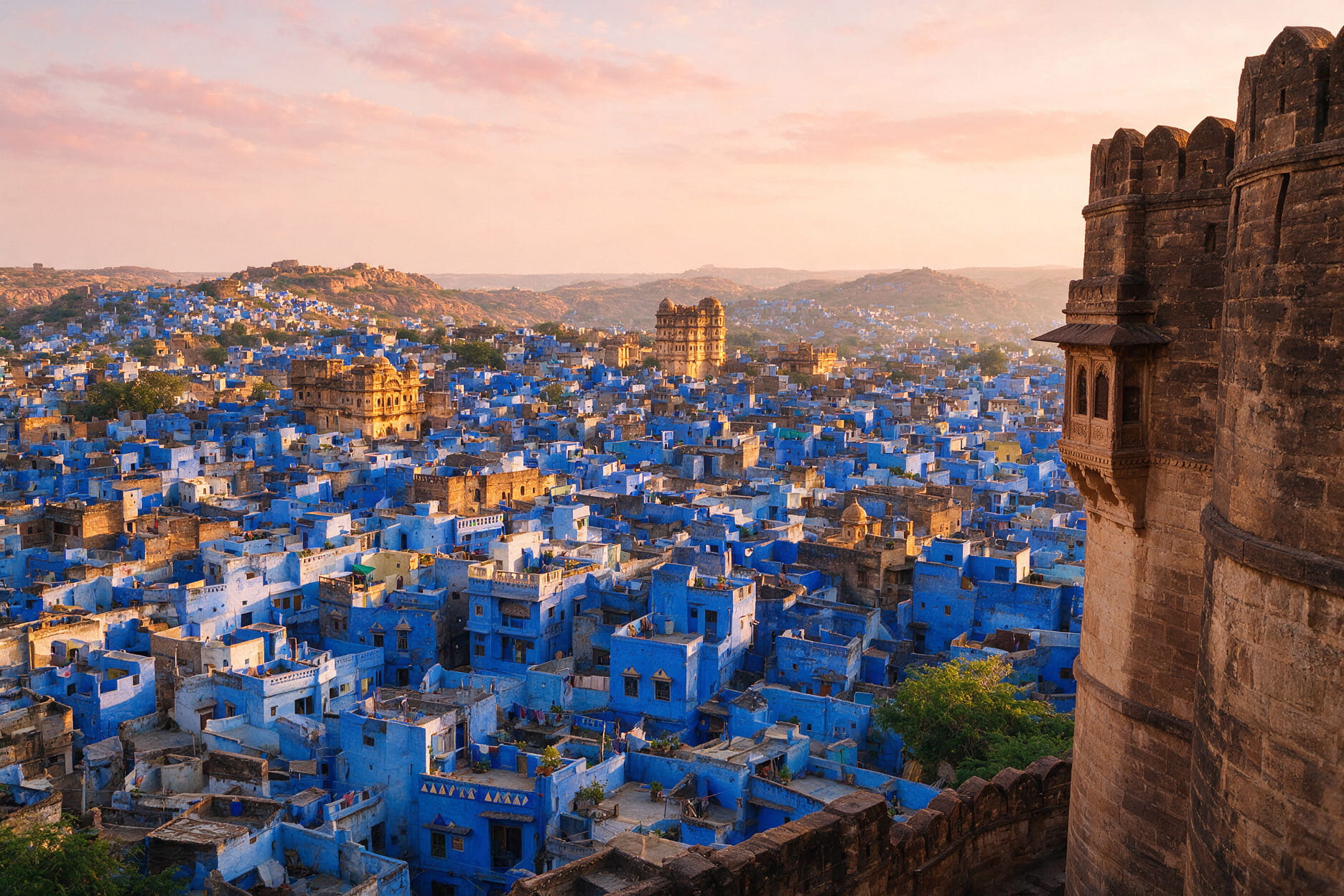
The blue is real. Not in a tourism-poster way where the colour has been pushed in post-production, but in the way that you turn a corner in the Brahmpuri lanes below Mehrangarh Fort and the walls on both sides, the doors, the window frames and the steps leading up to the next level are all painted the same pale indigo
Some accounts trace the colour to the Brahmin community, who painted their homes blue to distinguish them and, reportedly, to keep them cool. Others attribute it to the copper sulphate in the original whitewash acting as an insect repellent. Whatever the origin, the result is a city that photographs differently from any other in Rajasthan.
Jodhpur is a city of roughly 1.4 million people on the edge of the Thar Desert, built around a 15th century fort that sits 125 metres above the old city on a vertical cliff face.
Best Places to Visit in Jodhpur: A Practical Guide to the Blue City
The list below follows a logical visiting order rather than an alphabetical one. Mehrangarh comes first because the fort is the geographic and visual centre of everything else.
Mehrangarh Fort
Rao Jodha founded Jodhpur in 1459 and began building Mehrangarh on the cliff the same year. The fort was expanded by successive rulers over the next five centuries, which means the architectural style shifts as you move through it. The earliest sections are massive and defensive. The later additions, particularly the zenana galleries and the Phool Mahal, are finely detailed court interiors with gold leaf, mirror work and coloured glass.
The museum inside the fort is one of the better-maintained palace museums in Rajasthan. The collections include royal palanquins, elephant howdahs, Mughal miniature paintings, period weaponry and a set of turbans from the Marwar court. The audio guide, narrated and curated, is worth the additional cost.
The fort walls give the most complete view of the blue city below. The blue is most visible from the northern and western ramparts, particularly in the late afternoon when the light catches the painted walls at an angle.
Allow 2.5 to 3 hours minimum. The fort opens at 9 AM.
The Blue City Walk
The blue lanes of the old city are concentrated in the Brahmpuri neighbourhood and the streets between Nai Sarak and the base of the fort. The Navchokiya area has some of the most densely painted sections.
This is not a formal attraction with an entry gate. It is a residential area. Walking through the lanes is free and requires nothing more than comfortable shoes and a willingness to navigate narrow streets that occasionally end in someone’s courtyard. The light is best between 7 and 9 AM and again after 4 PM.
The walk combines naturally with a visit to Mehrangarh. Descend from the fort on foot through the old city rather than driving back, and the blue lanes unfold along the route.
Jaswant Thada
A white marble cenotaph built in 1899 in memory of Maharaja Jaswant Singh II. The structure sits on a hill overlooking a small lake, about a 10-minute walk from the fort entrance.
The marble used here is thin enough that sunlight passes through the sheets, creating a specific translucence in the interior chambers. Portraits of the Rathore rulers are displayed inside. The gardens around the cenotaph are quiet compared to the fort and are worth a stop before or after Mehrangarh rather than as a standalone visit.
Toorji Ka Jhalra Stepwell
A restored stepwell in the heart of the old city, about 500 metres from the Clock Tower. The stepwell was built in the 1740s by the queen of Maharaja Abhay Singh and was buried under silt and construction debris for decades before a restoration project cleared it in 2009.
The stepwell is surrounded by cafes on two sides, and several rooftop terraces overlook the structure. A quick 15-minute visit is sufficient for the stepwell itself, but the surrounding area has enough food and shopping to extend the stop.
Clock Tower and Sardar Market
The Ghanta Ghar, or Clock Tower, was built by Maharaja Sardar Singh and sits at the centre of the old city’s commercial area. Sardar Market radiates from the clock tower in every direction, with stalls selling spices, textiles, handicrafts, silver jewellery, leather goods and the lac bangles that Jodhpur is particularly known for.
The spice shops along the narrow lanes behind the tower sell whole mirchi, turmeric and the Rajasthani masala blends that are difficult to source outside this region. The best shopping hours are between 10 AM and 1 PM before the afternoon heat clears the lanes.
Umaid Bhawan Palace
Built between 1929 and 1943, Umaid Bhawan is one of the last great palaces built in India. The construction employed 3,000 workers for 15 years during a famine relief programme initiated by Maharaja Umaid Singh.
Part of the palace is a working hotel managed by the Taj group. Part remains the private residence of the Jodhpur royal family. And part is a museum open to visitors. The Art Deco interiors are the most distinctive feature, including a marble-floored indoor swimming pool and a series of rooms furnished entirely in 1930s European style.
The museum is about 5 km from the old city and requires a cab or auto.
Rao Jodha Desert Rock Park
A 72-hectare ecological park at the base of Mehrangarh Fort, opened in 2011 after a restoration project that removed the invasive Prosopis juliflora and replanted the area with native Thar Desert species. The park now contains over 300 species of plants across four walking trails ranging from 880 metres to 1,115 metres.
The red trail runs along the base of the fort walls and gives the most dramatic perspective of the cliff face. The best visiting time is early morning or late afternoon.
A Two-Day Jodhpur Plan
Day 1: Mehrangarh Fort from 9 AM, allow 3 hours. Walk down through the blue city lanes to Toorji Ka Jhalra. Lunch at one of the stepwell-facing rooftop cafes. Afternoon at Sardar Market and Clock Tower. Evening at Jaswant Thada before the gates close.
Day 2: Morning at Rao Jodha Desert Rock Park on the red trail. Midday at Umaid Bhawan Palace museum. Afternoon free for Mandore Gardens, about 9 km north, if time allows, or for revisiting the old city at a pace that the first day did not permit.
How to Reach Jodhpur by Bus
Jodhpur is connected by bus from Jaipur, Delhi and Udaipur. The Jodhpur bus booking page shows current schedules and options. The Jaipur to Jodhpur corridor is one of the busier Rajasthan routes and takes roughly 5 to 6 hours. The Delhi to Jodhpur overnight bus is another common approach.
Best Time to Visit
October through February is the practical season for places to visit in Jodhpur. November and December combine the most comfortable daytime temperatures with the clearest desert air. The Rajasthan International Folk Festival, held annually at Mehrangarh Fort, usually falls in October and brings live music performances inside the fort courtyards.
Summer temperatures in Jodhpur cross 45 degrees and make outdoor sightseeing impractical between April and June.
Frequently Asked Questions
What are the top places to visit in Jodhpur?
Mehrangarh Fort, the blue city walk, Jaswant Thada, Toorji Ka Jhalra, Clock Tower Market and Umaid Bhawan Palace.
How many days are enough for Jodhpur?
Two full days cover the essential places to visit in jodhpur comfortably, with Mehrangarh and the blue city on Day 1.
What is the best time to visit Jodhpur?
October through February offers comfortable temperatures and clear desert skies across the city.
Why is Jodhpur called the Blue City?
The Brahmpuri neighbourhood and surrounding old city lanes are painted pale blue, a tradition linked to the Brahmin community.
How far is Jodhpur from Jaipur by bus?
Jodhpur is about 330 km from Jaipur, covered in roughly 5 to 6 hours by bus.
Is Mehrangarh Fort worth visiting?
Mehrangarh is the single most important attraction in Jodhpur, with 500 years of architecture and a museum inside.
What can I buy at Sardar Market in Jodhpur?
Spices, lac bangles, textiles, silver jewellery and regional Rajasthani masala blends from the lanes around the Clock Tower.
Is Umaid Bhawan Palace open to visitors?
Part of Umaid Bhawan is a museum open to visitors, with Art Deco interiors and royal artifacts on display.
What is the Blue City walk in Jodhpur?
A free walk through the Brahmpuri neighbourhood and surrounding lanes, best done in early morning or late afternoon light.
Can I combine Jodhpur with a Rajasthan circuit?
Jodhpur fits between Jaipur and Jaisalmer on the standard Rajasthan route and connects by bus to both cities.