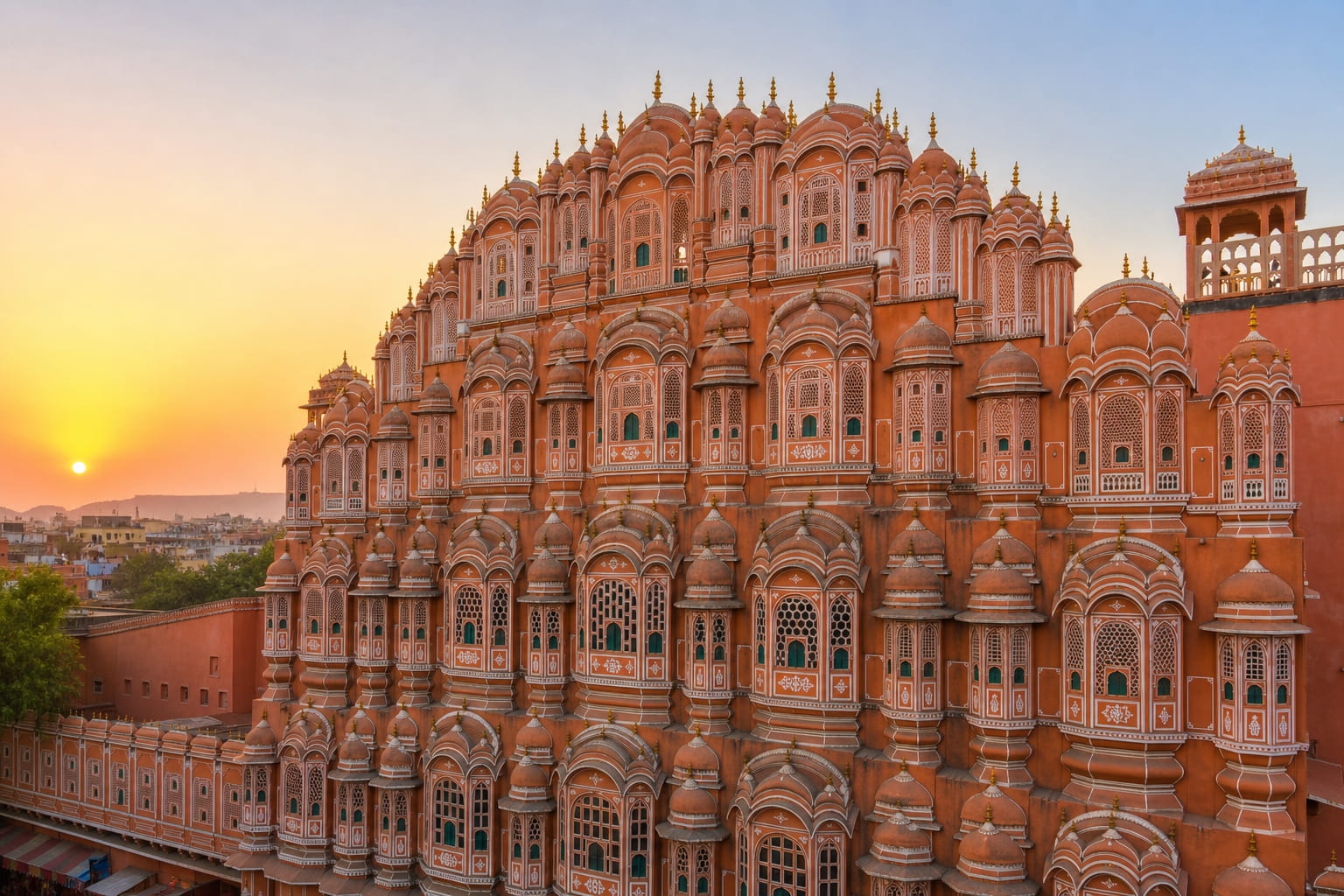
In 1876, the entire walled city of Jaipur was painted terracotta pink to welcome the visiting Prince of Wales. The tradition held, and more than a century later the colour is still here, applied to buildings across the old city and protected by municipal law. Jaipur is one of India’s most complete heritage destinations, and the places to visit in jaipur range from UNESCO World Heritage Sites to stepwells most visitors have never heard of.
This guide covers the forts, the palaces, the lesser-known stops, the shopping lanes, and the practical details you need to plan the trip. Book your Jaipur bus on zingbus and plan at least two full days for the city to feel unhurried.
Places to Visit in Jaipur: The Complete Pink City Guide
Jaipur was built in 1727 by Maharaja Jai Singh II, making it one of India’s first planned cities. The grid layout, the wide boulevards of the walled city, and the forts positioned strategically on the Aravalli ridge above it all reflect a single architectural vision from the beginning. Understanding this gives the places to visit in jaipur a coherence that a checklist approach misses.
The Forts: Start Here and Plan Your Day Around Them
The three forts of Jaipur sit on the same ridge and can be linked in a single visit with the right timing. Of the three, Amber Fort is the essential one. Jaigarh and Nahargarh each add something specific that Amber does not have.
Amber Fort
Amber Fort is 11 km from Jaipur’s city centre and is the most rewarding heritage site in the city. Built in 1592 by Raja Man Singh I, it was the capital of the Kachhwaha Rajput rulers before Jai Singh II moved the seat to the new city of Jaipur in 1727.
The fort covers roughly 4 square kilometres on a hilltop overlooking Maota Lake, and the reflection of its pale yellow and pink sandstone walls in the lake below is the view that most photographs of Amber use. The approach is either on foot up a cobbled ramp, by Jeep to the main gate, or by elephant ride, which is the traditional entry. Elephant rides are available but have faced periodic regulation on welfare grounds; check current availability before making it a fixed part of the plan.
Inside, the fort divides across four main courtyards. The most visited is the Sheesh Mahal, the Hall of Mirrors, where thousands of convex mirror chips set into the ceiling and walls create the effect of a star-filled sky when a single candle is lit. Inside the Sheesh Mahal is a specific feature called the Magic Flower, a carved marble panel that reveals the shape of a fish when half-covered, an elephant trunk when covered differently, and a corn cob from another angle. Guides know about it but only show it if you ask specifically.
The Diwan-e-Aam (Hall of Public Audience) and Sukh Niwas, where a channel of cool water once ran through the marble floors as a natural air conditioning system, are the other major interiors.
Entry fee: ₹100 Indians, ₹500 foreigners.
Timings: 8 AM to 5:30 PM.
Practical tip: Arrive at 8 AM. By 10:30 AM the narrow stairways between courtyards become congested. The 8 AM visit is a different experience from the 10 AM one.
Buy tickets online via obms-tourist.rajasthan.gov.in to skip counter queues.
Jaigarh Fort
Jaigarh Fort sits directly above Amber Fort on the ridge and is often combined into the same visit. The reason to come here is singular: the Jaivana Cannon, the world’s largest wheeled cannon. Cast in 1720, it has a barrel that measures over 6 metres and is mounted on a wheeled carriage that required four elephants to move it. It has never been fired in combat.
The fort also offers a long view across the Jaipur plains that Amber’s internal courtyards do not provide.
Entry fee: Check current combined ticket availability with Amber.
Timings: 9 AM to 4:30 PM.
Nahargarh Fort
Nahargarh Fort is on the same ridge but to the northwest, above the city itself rather than above Amber. The primary reason to visit Nahargarh is the sunset view of Jaipur, which is among the most photographed panoramas in Rajasthan. The fort walls and battlements in the foreground, the pink city spreading below, and the light changing as the sun drops behind the Aravalli hills make the late afternoon visit worth the drive.
The fort interior includes the Madhavendra Bhawan, a set of twelve identical suites built for the twelve queens of Maharaja Ram Singh II, each suite on a separate floor linked by a single internal corridor.
Entry fee: Modest; confirm at the gate.
Timings: 9 AM to 5 PM.
Inside the Walled City: Three Essential Stops
The walled city of Jaipur holds the three sites most central to understanding what the city was built around. All three are within walking distance or a short auto-rickshaw ride of each other.
City Palace
The City Palace complex in the heart of the walled city is still the official residence of the Jaipur royal family, making it unusual among India’s royal heritage properties. The Chandra Mahal, the seven-storey central palace tower, is the family’s private residence and visible from the outer courtyards. A portion of the complex is open to the public as a museum, with galleries displaying weapons, costumes, carpets, and royal manuscripts.
The Mubarak Mahal (a textile museum in an Indo-Saracenic building), the Sileh Khana (the armoury), and the main Diwan-e-Khas, which holds two enormous silver urns recognised in the Guinness World Records as the world’s largest sterling silver objects, are the key sections.
Entry fee: ₹200 for Indians (general); premium options with additional access available. Foreigners higher; check current rates at the gate.
Timings: 9:30 AM to 5 PM.
Hawa Mahal
Hawa Mahal, the Palace of Winds, is Jaipur’s most recognisable building and the image most associated with the city internationally. Built in 1799 by Maharaja Sawai Pratap Singh, it is a five-storey facade of pink sandstone with 953 latticed windows called jharokhas. The exterior is designed to resemble the crown of Lord Krishna.
The functional purpose was specific and clever: the latticed windows allowed the women of the royal zenana (court) to observe street life, processions, and festivals below without being visible to the public. The cross-ventilation through the honeycombed facade also created a natural cooling effect, giving the building its name.
Visiting Hawa Mahal involves going around to the back entrance, which most visitors miss from the main road. Inside, the narrow passages climb through the five storeys to small balcony chambers with outward-facing windows. The view of the street and the facade architecture from the upper levels is the reward.
Entry fee: ₹50 Indians, ₹200 foreigners.
Timings: 9 AM to 5 PM.
Best light for photography: 9 to 11 AM, when the sun illuminates the facade.
Jantar Mantar
Jantar Mantar in Jaipur is the largest of the five astronomical observatories built by Maharaja Jai Singh II in the early 18th century, the others being in Delhi, Ujjain, Mathura, and Varanasi. It is a UNESCO World Heritage Site. The instruments are not museum exhibits. They were designed and built as functional scientific tools and still produce accurate astronomical calculations.
The most famous instrument is the Samrat Yantra, the world’s largest sundial, whose triangular gnomon stands 27 metres tall and can calculate the local time to within two seconds. The other instruments track celestial bodies, predict eclipses, and monitor the positions of stars and planets.
Without a guide, Jantar Mantar reads as an open area with large geometric stone structures. With a guide, each instrument becomes a piece of functioning science from the early 18th century. Hiring a guide or using the audio guide at the entrance is strongly recommended.
Entry fee: ₹50 Indians, ₹200 foreigners. Children under 7 are usually free.
Timings: 9 AM to 5 PM.
Beyond the Usual Circuit: Four Places Worth Adding
These four sites are often skipped by visitors on short trips. Each adds something specific to the Jaipur experience.
Panna Meena Ka Kund
Panna Meena Ka Kund is a stepwell in the Amer area, about 500 metres from the Amber Fort entrance. It is one of the most geometrically satisfying examples of stepwell construction in Rajasthan, with a double-zigzag staircase pattern that creates a symmetric design when photographed from the upper rim. The stepwell is rarely crowded, even on the same days when Amber Fort is packed. Entry is free.
Jal Mahal
Jal Mahal is a palace on Man Sagar Lake, about 10 km from the city centre. The palace appears to float on the water. Only the top storey is visible; four lower storeys are submerged when the lake is full. The palace is not open to visitors, but the lakeside road and the view across the water to the palace and the hills behind it are among the most pleasant scenes in the city. Visit at sunrise or early evening.
Galtaji (The Monkey Temple)
Galtaji is a complex of Hindu temples about 12 km east of Jaipur, set within a rocky valley at the edge of the Aravalli hills. The complex has several kunds, natural spring-fed water tanks where pilgrims bathe, and is home to large troops of langur and rhesus monkeys that move freely through the temple courts. The setting, with the cliff faces around it, gives Galtaji a completely different atmosphere from the forts and palaces.
The walk from the main road up through the valley to the upper temple adds a half-hour on foot that most visitors find the best part of the visit.
Albert Hall Museum
The Albert Hall Museum in the Ram Niwas Garden is the oldest museum in Rajasthan, opened in 1887. The building itself, designed in Indo-Saracenic style, is worth visiting for the architecture alone. Inside, the collection covers carpets, crystal, ivory, coins, terracotta, and a complete Egyptian mummy. It is less crowded than the forts and often underestimated as a destination.
Entry fee: ₹40 Indians, ₹300 foreigners.
Timings: 9 AM to 5 PM (closed Mondays).
Jaipur’s Bazaars: Where to Shop
The walled city’s bazaars are organised by trade, a layout that dates to the original city plan. Each lane specialises in a specific craft or product.
Johari Bazaar is Jaipur’s jewellery district, the largest concentration of kundan (glass-and-gold setting) and meenakari (enamel work) jewellery in India. Prices at the larger shops can be negotiated; the smaller workshop-facing shops on the side lanes often produce the same quality at lower prices.
Bapu Bazaar runs parallel to the main road and carries block-printed textiles, juttis (hand-embroidered leather footwear), and leheriya (tie-dye fabric). It is the most tourist-oriented of the markets and prices reflect this; bargaining is standard.
Tripolia Bazaar, near Hawa Mahal, specialises in traditional lac bangles, brassware, and metal craft. The bangle workshops here are some of the oldest in the city.
Nehru Bazaar, near Ajmeri Gate, is the most specific: it is almost exclusively juttis, the embroidered leather shoes that are Jaipur’s most distinctive craft product. Prices here are lower than in the more visible markets on the main road.
How Long Do You Need in Jaipur?
Two full days covers the essential places to visit in jaipur: the Amber-Jaigarh-Nahargarh fort circuit on day one, and the walled city (City Palace, Hawa Mahal, Jantar Mantar) plus shopping on day two.
Three days allows you to add Panna Meena Ka Kund, Jal Mahal, Galtaji, and a more relaxed pace through the markets.
Four or more days open up the day trips: Sambhar Lake (~80 km), Samode Palace (~42 km), and Ajmer-Pushkar (~135 km).
The composite ticket covers Amber Fort, Hawa Mahal, Jantar Mantar, Nahargarh Fort, and several other monuments for ₹300 Indians / ₹1,000 foreigners, valid for 2 days. Buy it at any of the included monuments. It is the most efficient option for a 2-day visit.
Best Time to Visit Jaipur
October to March is the best time for Jaipur. Temperatures range from 10°C to 27°C, outdoor sightseeing is comfortable, and the light is good across the forts and palaces for most of the day.
April to June is very hot, with temperatures regularly reaching 42 to 45°C. Outdoor sightseeing becomes difficult from late morning. Summer visitors should plan fort visits before 10 AM and focus on indoor attractions in the afternoon.
July to September brings the monsoon. Jaipur receives moderate rainfall and the forts and surrounding hills turn green. Crowds are thinner and prices are lower, but the heat and humidity remain high.
How to Reach Jaipur
Jaipur is 280 km from Delhi by road and is one of the most well-connected cities in northern India for bus travel. zingbus operates approximately 30 daily services on the Delhi-Jaipur corridor, with further connections to Gurgaon, Udaipur, Agra, Jodhpur, Ahmedabad, and other cities.
From Delhi, check the Jaipur to Delhi bus for return route schedules and fares on zingbus. Book both legs before you travel; weekend return slots fill quickly.
Jaipur’s two main boarding points for zingbus are Sindhi Camp (M.I. Road area) and Narayan Singh Circle.
You Might Also Like
- Places to Visit in Udaipur: Udaipur is the natural next destination on a Rajasthan circuit from Jaipur, with zingbus running regular services between the two cities.
- 25 Must-Visit Places in India: Jaipur features prominently in this national travel reference alongside other bus-accessible heritage destinations.
- How to Plan a Road Trip in India: Practical planning guidance for anyone building a longer Golden Triangle or Rajasthan circuit with Jaipur as the first or last stop.
Tips for Visiting Jaipur
- Buy the composite ticket at your first monument. It covers Amber Fort, Hawa Mahal, Jantar Mantar, Nahargarh, and other sites for two days and saves both money and queue time.
- Arrive at Amber Fort by 8 AM. The difference between an 8 AM and a 10 AM visit is significant. The morning is quieter, cooler, and the light on the lake reflection is better.
- Book Amber Fort tickets online via obms-tourist.rajasthan.gov.in to skip the counter queue in peak season.
- Ask your Amber Fort guide to show you the Magic Flower in the Sheesh Mahal specifically. It will not be volunteered.
- Hire a guide at Jantar Mantar. Without one, the instruments are visually interesting but contextually opaque. With one, each structure becomes a piece of 18th-century science.
- Nahargarh Fort is best in the late afternoon from 3 PM onward for the sunset view over Jaipur.
- Panna Meena Ka Kund is 500 metres from Amber Fort’s entrance and takes 20 minutes. It is almost always empty even when Amber is crowded.
- The walled city bazaars are most active in the morning. By 2 to 3 PM, the heat slows everything and some smaller shops close for a midday break.
- October to March is the best season. Carry water and sunscreen even in winter; Rajasthan sun is intense even in December.
- Jaipur’s auto-rickshaws operate on negotiated fares. Agree before getting in; the standard practice applies throughout the city.
Jaipur Gives Back What You Put Into It
A two-day Jaipur trip that begins at Amber at 8 AM and ends at Nahargarh at sunset covers the essential places to visit in jaipur without feeling rushed. A three-day visit adds the stepwells, the monkey temple, and a proper morning at each of the walled city’s major sites. The city’s heritage rewards the visitor who allows time at each place rather than moving through a checklist quickly. Amber’s Sheesh Mahal alone, with the right guide, justifies the early start.
The Pink City is not just a nickname for marketing purposes. The colour is maintained, the bazaars are still organised by trade as they were in 1727, and the Jaipur royal family still occupies the Chandra Mahal at the center of the City Palace. Most of what was built three hundred years ago here is still standing and still in use.
Frequently Asked Questions
What are the best places to visit in Jaipur?
The best places to visit in jaipur include Amber Fort, City Palace, Hawa Mahal, Jantar Mantar, Nahargarh Fort, Jaigarh Fort, Panna Meena Ka Kund, Jal Mahal, Galtaji Temple, and Albert Hall Museum.
How many days are enough for Jaipur?
Two full days covers the essential forts, the walled city’s main three sites, and a walk through the bazaars; three days allows for the lesser-known spots and a more relaxed pace.
What is the entry fee for Amber Fort in 2026?
The Amber Fort entry fee in 2026 is ₹100 for Indian nationals and ₹500 for foreign tourists; the composite ticket at ₹300 (Indians) and ₹1,000 (foreigners) covers Amber and several other Jaipur monuments for two days.
What is the best time to visit Jaipur?
October to March is the best time to visit Jaipur, with pleasant temperatures between 10°C and 27°C for comfortable outdoor sightseeing at the forts and palaces.
Why is Jaipur called the Pink City?
Jaipur is called the Pink City because the entire walled city was painted terracotta pink in 1876 to welcome Prince Albert of Wales; the tradition has been maintained and the pink colour is now protected by municipal regulation.
Is Hawa Mahal worth visiting in Jaipur?
Yes, Hawa Mahal is worth visiting both for the facade exterior and the interior climb to the upper balcony chambers; the 953 latticed windows and the view from the top floors make it one of the most architecturally distinctive buildings in India.
What is the Jaivana Cannon at Jaigarh Fort?
The Jaivana Cannon at Jaigarh Fort near Jaipur is the world’s largest wheeled cannon, cast in 1720, with a barrel over 6 metres long; it required four elephants to move and was never fired in combat.
Can I buy a composite ticket for Jaipur monuments?
Yes, a composite ticket priced at ₹300 for Indians and ₹1,000 for foreigners covers Amber Fort, Hawa Mahal, Jantar Mantar, Nahargarh Fort, and other monuments and is valid for two days; buy it at any of the covered monuments.